


Page 23 - Spotlight A+ Form 4 & 5 Chemistry KSSM
P. 23
Form
                                                                                                           4
                                                                    Chapter 5 Chemical Bond   Chemistry
                                                          Section C
                  SPM Clone
                        23
                               16
                   5.  (a)  J and  L are symbols of two atoms.
                        11
                               8
                        Explain how atoms J and L can form ions and write the formulae of  the ions formed.   C4  [4 marks]
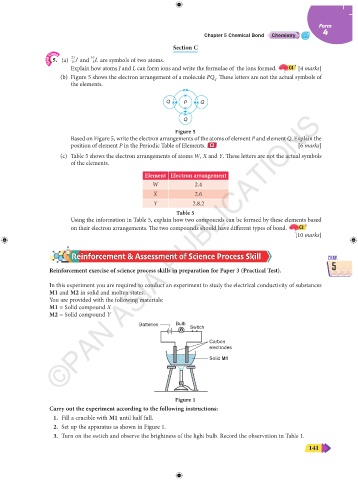
                     (b)  Figure 5 shows the electron arrangement of a molecule PQ . These letters are not the actual symbols of
                                                                       3
                        the elements.
                                                       Q     P     Q

                                                             Q
                                                           Figure 5
                        Based on Figure 5, write the electron arrangements of the atoms of element P and element Q. Explain the
                        position of element P in the Periodic Table of Elements.  C2               [6 marks]
                     (c)  Table 5 shows the electron arrangements of atoms W, X and Y. These letters are not the actual symbols
                        of the elements.

                                                Element Electron arrangement
                                                   W             2.4
                                                   X             2.6
                                                   Y            2.8.2
                                                           Table 5
                        Using the information in Table 5, explain how two compounds can be formed by these elements based
                        on their electron arrangements. The two compounds should have different types of bond.   C3
                                                                                                  [10 marks]


                         Reinforcement & Assessment of Science Process Skill
 CHAP.              ©PAN ASIA PUBLICATIONS                                                                   CHAP.
 5               Reinforcement exercise of science process skills in preparation for Paper 3 (Practical Test).  5


                 In this experiment you are required to conduct an experiment to study the electrical conductivity of substances
                 M1 and M2 in solid and molten states.
                 You are provided with the following materials:
                 M1 = Solid compound X
                 M2 = Solid compound Y

                                               Batteries   Bulb
                                                               Switch

                                                                      Carbon
                                                                      electrodes
                                                                      Solid M1


                                                           Figure 1
                 Carry out the experiment according to the following instructions:
                   1.  Fill a crucible with M1 until half full.
                   2.  Set up the apparatus as shown in Figure 1.
                   3.  Turn on the switch and observe the brightness of the light bulb. Record the observation in Table 1.

                                                                                                      141

