


Page 22 - Spotlight A+ Form 4 & 5 Chemistry KSSM
P. 22
Form
           4
                      Chemistry   Chapter 5 Chemical Bond
                 (d)  Based on the information in Table 2.1, classify substances X, Y and Z according to their solubility in
                    water.   C3
                     Solubility in water             Soluble                       Insoluble
                     Substance
                                          (i)                              (ii)

                                                                           (iii)
                                                      Table 2.2
                                                                                               [3 marks]
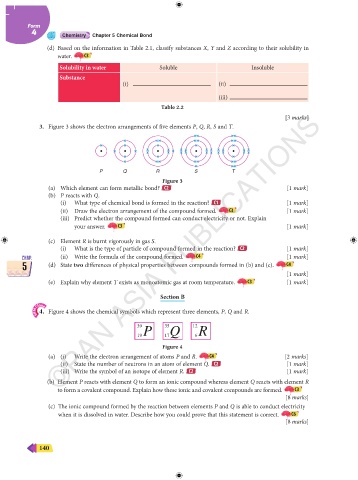
               3.  Figure 3 shows the electron arrangements of five elements P, Q, R, S and T.


                                  P      Q          R            S           T
                                                      Figure 3
                 (a)  Which element can form metallic bond?  C2                                 [1 mark]
                 (b)  P reacts with Q.
                     (i)   What type of chemical bond is formed in the reaction?  C1            [1 mark]
                     (ii)  Draw the electron arrangement of the compound formed.   C3           [1 mark]
                     (iii)  Predict whether the compound formed can conduct electricity or not. Explain
                         your answer.   C3                                                      [1 mark]

                 (c)  Element R is burnt vigorously in gas S.
                     (i)
                                                                                               [1 mark]
                    ©PAN ASIA PUBLICATIONS
                         What is the type of particle of compound formed in the reaction?  C2
        CHAP.        (ii)  Write the formula of the compound formed.   C4                       [1 mark]                                                                                                                 CHAP.
        5        (d)  State two differences of physical properties between compounds formed in (b) and (c).   C4                                                                                                          5
                                                                                               [1 mark]
                 (e)  Explain why element T exists as monoatomic gas at room temperature.   C3  [1 mark]

                                                      Section B

             SPM Clone
               4.  Figure 4 shows the chemical symbols which represent three elements, P, Q and R.

                                              39 P     35       12 R
                                              19       17Q       6
                                                      Figure 4
                 (a)  (i)   Write the electron arrangement of atoms P and R.   C4             [2 marks]
                     (ii)  State the number of neutrons in an atom of element Q.  C2           [1 mark]
                     (iii)  Write the symbol of an isotope of element R.  C2                   [1 mark]
                 (b)  Element P reacts with element Q to form an ionic compound whereas element Q reacts with element R
                    to form a covalent compound. Explain how these ionic and covalent compounds are formed.   C3
                                                                                               [8 marks]
                  (c)  The ionic compound formed by the reaction between elements P and Q is able to conduct electricity
                    when it is dissolved in water. Describe how you could prove that this statement is correct.   C6
                                                                                               [8 marks]


              140

