


Page 27 - Spotlight A+ Form 4 & 5 Chemistry KSSM
P. 27
Form
           5          Chemistry   Chapter 1 Redox Equilibrium

        CHAP.                                                                                                                                                                                                            CHAP.
         1         Activity       1.2                                                                                                                                                                                     1


              Aim:
              To investigate the conversion of iron(II) ion, Fe  to     4.  The mixture is filtered into a test tube.
                                                    2+
                          3+
              iron(III) ion, Fe  and vice versa.
              Materials:
                        –3
              0.5 mol dm  freshly prepared iron(II) sulphate,   Test to confirm the presence of iron(II) ion, Fe .
                                                                                                2+
                                       –3
              FeSO  solution, 0.5 mol dm  iron(III) chloride,
                  4
                    ©PAN ASIA PUBLICATIONS
              FeCl  solution, bromine water, Br , zinc, Zn powder,
                  3                     2
              filter paper, 2.0 mol dm  sodium hydroxide, NaOH     5.  0.2  mol dm  of sodium hydroxide, NaOH
                                                                          –3
                                 –3
              solution                                         solution is added drop by drop until in excess.
                                                               The changes are recorded.
              Apparatus:
              Dropper, spatula, test tube holder, Bunsen burner,   Observation:
              filter  funnel,  test  tube  rack,  measuring  cylinder,      Table 1.2
              test tube
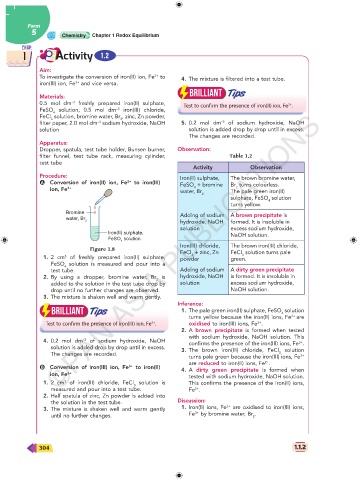
                                                                Activity           Observation
              Procedure:                                    Iron(II) sulphate,   The brown bromine water,
                                           2+
              A  Conversion of iron(II) ion, Fe  to iron(III)   FeSO  + bromine   Br  turns colourless.
                 ion, Fe 3+                                      4            2
                                                            water, Br        The pale green iron(II)
                                                                   2
                                                                             sulphate, FeSO  solution
                                                                                         4
                                                                             turns yellow.
                       Bromine                              Adding of sodium  A brown precipitate is
                       water, Br
                             2
                                                            hydroxide, NaOH   formed. It is insoluble in
                                                            solution         excess sodium hydroxide,
                                    Iron(II) sulphate,                       NaOH solution.
                                    FeSO  solution
                                         4
                               Figure 1.8                   Iron(III) chloride,   The brown iron(III) chloride,
                                                            FeCl  + zinc, Zn   FeCl  solution turns pale
                                                                                3
                                                                3
                1.  2  cm  of freshly prepared iron(II) sulphate,   powder   green.
                      3
                  FeSO  solution is measured and pour into a
                      4
                  test tube.                                Adding of sodium  A dirty green precipitate
                2.  By  using a dropper, bromine water, Br  is   hydroxide, NaOH   is formed. It is insoluble in
                                                    2
                  added to the solution in the test tube drop by   solution  excess sodium hydroxide,
                  drop until no further changes are observed.                NaOH solution.
                3.  The mixture is shaken well and warm gently.
                                                           Inference:
                                                             1.  The pale green iron(II) sulphate, FeSO  solution
                                                                                             4
                                                                                                 2+
                                                               turns yellow because the iron(II) ions, Fe are
                Test to confirm the presence of iron(III) ion, Fe .  oxidised to iron(III) ions, Fe .
                                                   3+
                                                                                     3+
                                                             2.  A  brown precipitate is formed when tested
                                                               with  sodium  hydroxide,  NaOH  solution.  This
                            –3
                4.  0.2  mol dm  of sodium hydroxide, NaOH     confirms the presence of the iron(III) ions, Fe .
                                                                                                   3+
                  solution is added drop by drop until in excess.     3.  The  brown iron(III) chloride, FeCl  solution
                  The changes are recorded.                                                 3      3+
                                                               turns pale green because the iron(III) ions, Fe
                                                               are reduced to iron(II) ions, Fe .
                                                                                        2+
              B  Conversion of iron(III) ion, Fe  to iron(II)
                                           3+
                                                             4.  A  dirty green precipitate is formed when
                 ion, Fe 2+
                                                               tested with sodium hydroxide, NaOH solution.
                      3
                1.  2  cm  of iron(III) chloride,  FeCl  solution  is   This confirms the presence of the iron(II) ions,
                                             3
                  measured and pour into a test tube.          Fe .
                                                                 2+
                2.  Half spatula of zinc, Zn powder is added into
                  the solution in the test tube.             Discussion:
                                                                           2+
                3.  The  mixture is shaken well and warm gently     1.  Iron(II) ions, Fe  are oxidised to iron(III) ions,
                                                                 3+
                  until no further changes.                    Fe  by bromine water, Br .
                                                                                    2
              304                                                                                 1.1.2

