


Page 28 - Spotlight A+ Form 4 & 5 Chemistry KSSM
P. 28
Form
                                                                                                           5
                                                                   Chapter 1 Redox Equilibrium  Chemistry
 CHAP.              2.  Bromine water, Br  acts as the oxidising agent,     5.  Iron(III)  ions, Fe  are reduced to iron(II) ions,   CHAP.
                                                                                3+
 1                    whereas iron(II) ions, Fe  act as the reducing   Fe  by zinc, Zn.                       1
                                    2
                                                                     2+
                                          2+
                                                                                3+
                      agent.                                      6.  Iron(III)  ion, Fe  act as the oxidising agent
                    3.  An iron(II) ion, Fe  loses an electron to form   whereas zinc, Zn acts as the reducing agent.
                                    2+
                                                        2+
                      iron(III) ion, Fe . Thus, iron(II) ion, Fe  is     7.  A zinc atom loses two electrons to form zinc
                                   3+
                      oxidised to iron(III) ion, Fe .              ion,  Zn .  Thus,  zinc  atom,  Zn  is oxidised  to
                                           3+
                                                                         2+
                                                                             2+
                    4.  A  bromine molecule, Br   receives two     zinc ion, Zn .
                                             2
                      electrons from iron(II) ion, Fe  to form     8.  An iron(III) ion, Fe  receives an electron from
                                                                                  3+
                                                  2+
                                                                                            2+
                                   –
                      bromide ions, Br . Thus, bromine molecule, Br    zinc, Zn to form iron(II) ion, Fe . Thus, iron(III)
                                                           2
                                                                                                 2+
                      is reduced to bromide ions, Br .             ion, Fe  is reduced to iron(II) ion, Fe .
                                                                         3+
                                               –
                    ©PAN ASIA PUBLICATIONS
                        Oxidation half equation:                    Oxidation half equation:
                        Fe (aq) → Fe (aq) + e –                     Zn(s) → Zn (aq) + 2e –
                          2+
                                   3+
                                                                             2+
                        Reduction half equation:                    Reduction half equation:
                        Br (aq) + 2e  → 2Br (aq)                      3+      –     2+
                                  –
                                        –
                          2                                         Fe (aq) + e  → Fe (aq)
                        Overall ionic equation (Redox reaction):    Overall ionic equation (Redox reaction):
                           2+
                                                       –
                                             3+
                        2Fe (aq) + Br (aq) → 2Fe (aq) + 2Br (aq)       3+               2+       2+
                                    2                               2Fe (aq) + Zn(s) → 2Fe (aq) + Zn (aq)
                                                                                    Try Question 7 in Formative Zone 1.1
                 Name compound using the IUPAC nomenclature       5.  For  anions which contain  metal that have
                   1.  Many elements have just one oxidation number,   variable oxidation numbers, the oxidation
                     but  some  elements  such  as  transition  metals,   number of the metal ion are written in Roman
                     carbon,  nitrogen  and  sulphur  have  more than   numeral in brackets, immediately following the
                     one oxidation number.                          name of the anion.
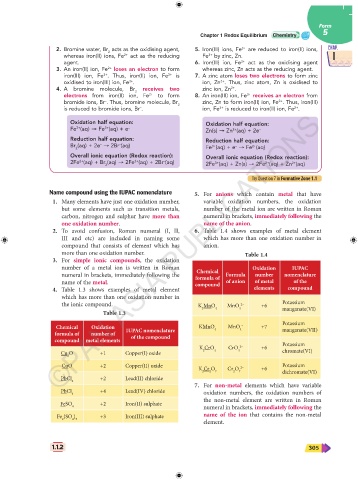
                   2.  To avoid confusion, Roman numeral (I, II,     6.  Table 1.4 shows examples of metal element
                     III and etc) are included in naming some       which has more than one oxidation number in
                     compound that consists of element which has    anion.
                     more than one oxidation number.                             Table 1.4
                   3.  For  simple ionic compounds,  the  oxidation
                     number of a metal ion is written in Roman   Chemical           Oxidation    IUPAC
                     numeral in brackets, immediately following the   formula of   Formula   number   nomenclature
                     name of the metal.                          compound  of anion  of metal    of the
                   4.  Table 1.3 shows examples of metal element                    elements   compound
                     which has more than one oxidation number in
                     the ionic compound.                          K MnO 4   MnO 4 2–   +6     Potassium
                                                                                              manganate(VI)
                                                                   2
                                   Table 1.3
                                                                                              Potassium
                   Chemical    Oxidation   IUPAC nomenclature     KMnO 4    MnO 4 –    +7     manganate(VII)
                   formula of   number of   of the compound
                   compound  metal elements
                                                                  K CrO     CrO  2–    +6     Potassium
                     Cu O         +1      Copper(I) oxide           2  4       4              chromate(VI)
                       2
                     CuO          +2      Copper(II) oxide                                    Potassium
                                                                  K Cr O 7  Cr O 7 2–  +6     dichromate(VI)
                                                                             2
                                                                      2
                                                                   2
                     PbCl 2       +2      Lead(II) chloride
                                                                  7.  For  non-metal elements which have variable
                     PbCl         +4      Lead(IV) chloride
                         4                                          oxidation numbers, the oxidation numbers of
                                                                    the non-metal element are written in Roman
                     FeSO         +2      Iron(II) sulphate
                         4                                          numeral in brackets, immediately following the
                    Fe (SO )      +3      Iron(III) sulphate        name of the ion  that  contains  the  non-metal
                     2   4 3
                                                                    element.
                  1.1.2                                                                               305

