Page 29 - Spotlight A+ Form 4 & 5 Chemistry KSSM
P. 29
Form
           5          Chemistry   Chapter 1 Redox Equilibrium

        CHAP.                                                                                                                                                                                                            CHAP.
         1     8.  Zinc,  Zn  strip  is  placed  into silver  nitrate,   (a)  Oxidation half equation                                                                                                                     1
                 Ag(NO )  solution. Silver, Ag and zinc nitrate,
                       3 2                                      (b)  Reduction half equation
                 Zn(NO )  are formed.                           (c)  Overall ionic equation
                       3 2
                   Zn(s) + 2AgNO (aq) → Ag(s) + Zn(NO ) (aq)    (d)  Oxidising agent
                               3                  3 2           (e)  Reducing agent
                  Based on the reaction equation, determine the
                 following:   C3
               1.2    Standard Electrode Potential             potential of an unknown half-cell with a
                                                               standard electrode.  Hydrogen  electrode was
                    ©PAN ASIA PUBLICATIONS
               1.  The  strength  of an  oxidising agent  and  a   chosen as a standard electrode.
                 reducing agent depends on the  standard
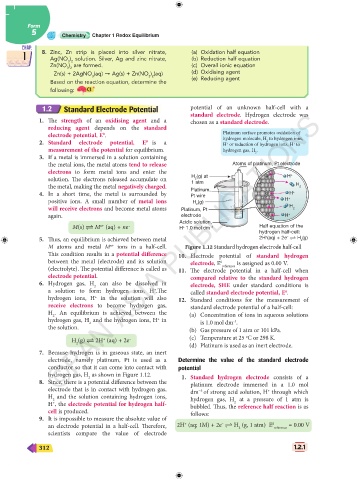
                 electrode potential, E .                                 Platinum surface promotes oxidation of
                                   0
               2.  Standard  electrode  potential,   E 0   is  a          hydrogen molecule, H  to hydrogen ions,
                                                                                        2
                                                                          H  or reduction of hydrogen ions, H  to
                                                                                                 +
                                                                           +
                 measurement of the potential for equilibrium.            hydrogen gas, H .
                                                                                     2
               3.  If a metal is immersed in a solution containing
                 the metal ions, the metal atoms tend to release             Atoms of platinum, Pt electrode
                 electrons to form metal ions and enter the
                 solution. The electrons released accumulate on   H (g) at              e –    H +
                                                                 2
                                                                1 atm
                 the metal, making the metal negatively charged.                                  H 2
               4.  In  a  short  time,  the  metal  is  surrounded  by   Platinum,      e –     H +
                                                                Pt wire
                 positive ions.  A small  number  of  metal ions   H (g)               e –    H +
                                                                 2
                 will receive electrons and become metal atoms   Platinum, Pt          e –      H 2
                 again.                                     electrode                   e –   H +
                                                            Acidic solution,
                         M(s)  M  (aq) + ne –              H  1.0 mol dm –3          Half equation of the
                                  n+
                                                             +
                                                                                      hydrogen half-cell:
                                                                                               –
               5.  Thus, an equilibrium is achieved between metal                     2H (aq) + 2e   H (g)
                                                                                        +
                                                                                                    2
                                     n+
                 M atoms and metal  M  ions  in  a half-cell.   Figure 1.12 Standard hydrogen electrode half-cell
                 This condition results in a potential difference    10.  Electrode  potential of  standard hydrogen
                 between the metal (electrode) and its solution   electrode, E 0   is assigned as 0.00 V.
                                                                          reference
                 (electrolyte). The potential difference is called as    11.  The  electrode  potential  in  a  half-cell  when
                 electrode potential.                          compared relative to the  standard hydrogen
               6.  Hydrogen  gas, H  can also be dissolved in   electrode, SHE under standard conditions is
                                2
                                                    +
                 a solution to form hydrogen ions, H .The      called standard electrode potential, E .
                                                                                               0
                                +
                 hydrogen ions, H  in the solution will also    12.  Standard conditions for the measurement of
                 receive electrons to become hydrogen gas,     standard electrode potential of a half-cell:
                 H .  An  equilibrium is achieved between the   (a)  Concentration of ions in aqueous solutions
                  2
                 hydrogen gas, H  and the hydrogen ions, H  in     is 1.0 mol dm .
                                                     +
                                                                              -3
                              2
                 the solution.                                 (b)  Gas pressure of 1 atm or 101 kPa.
                                                                                  o
                        H (g)  2H  (aq) + 2e –                (c)  Temperature at 25  C or 298 K.
                                   +
                          2
                                                               (d)  Platinum is used as an inert electrode.
               7.  Because  hydrogen is in gaseous state, an inert
                 electrode,  namely platinum,  Pt  is  used  as a   Determine the value of the standard electrode
                 conductor so that it can come into contact with   potential
                 hydrogen gas, H  as shown in Figure 1.12.    1.  Standard  hydrogen electrode consists of a
                              2
               8.  Since, there is a potential difference between the   platinum electrode immersed in a 1.0 mol
                 electrode that is in contact with hydrogen gas,   dm of strong acid solution, H  through which
                                                                  −3
                                                                                         +
                 H  and the solution containing hydrogen ions,   hydrogen gas, H  at a pressure of 1 atm is
                  2
                 H , the electrode potential for hydrogen half-  bubbled. Thus, the reference half reaction is as
                                                                              2
                  +
                 cell is produced.                             follows:
               9.  It is impossible to measure the absolute value of
                                                                          –
                                                              +
                 an electrode potential in a half-cell. Therefore,   2H  (aq; 1M) + 2e   H  (g, 1 atm)  E 0 reference  = 0.00 V
                                                                               2
                 scientists compare the  value of  electrode
              312                                                                                1.2.1
   24   25   26   27   28   29   30   31   32   33   34