


Page 31 - Spotlight A+ Form 4 & 5 Chemistry KSSM
P. 31
Form
5 Chemistry Chapter 1 Redox Equilibrium
0
0
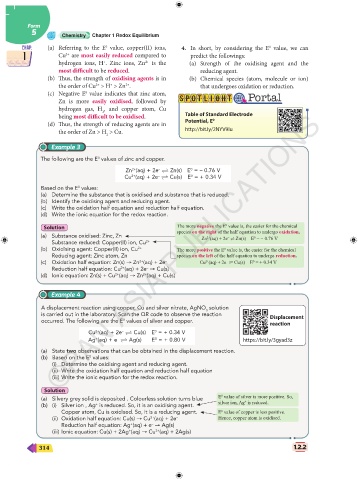
CHAP. (a) Referring to the E value, copper(II) ions, 4. In short, by considering the E value, we can CHAP.
1 Cu are most easily reduced compared to predict the followings: 1
2+
hydrogen ions, H . Zinc ions, Zn is the (a) Strength of the oxidising agent and the
2+
+
most difficult to be reduced. reducing agent.
(b) Thus, the strength of oxidising agents is in (b) Chemical species (atom, molecule or ion)
the order of Cu > H > Zn . that undergoes oxidation or reduction.
2+
2+
+
(c) Negative E value indicates that zinc atom,
0
Zn is more easily oxidised, followed by
hydrogen gas, H , and copper atom, Cu
2
being most difficult to be oxidised. Table of Standard Electrode
©PAN ASIA PUBLICATIONS
(d) Thus, the strength of reducing agents are in Potential, E 0
the order of Zn > H > Cu. http://bit.ly/2NYV9lu
2
Example 3
The following are the E values of zinc and copper.
0
0
–
Zn (aq) + 2e Zn(s) E = – 0.76 V
2+
0
2+
–
Cu (aq) + 2e Cu(s) E = + 0.34 V
Based on the E values:
0
(a) Determine the substance that is oxidised and substance that is reduced.
(b) Identify the oxidising agent and reducing agent.
(c) Write the oxidation half equation and reduction half equation.
(d) Write the ionic equation for the redox reaction.
0
Solution The more negative the E value is, the easier for the chemical
species on the right of the half equation to undergo oxidation.
(a) Substance oxidised: Zinc, Zn Zn (aq) + 2e ⇌ Zn(s) E = – 0.76 V
–
0
2+
2+
Substance reduced: Copper(II) ion, Cu
(b) Oxidising agent: Copper(II) ion, Cu 2+ The more positive the E value is, the easier for the chemical
0
Reducing agent: Zinc atom, Zn species on the left of the half equation to undergo reduction.
–
0
2+
(c) Oxidation half equation: Zn(s) → Zn (aq) + 2e – Cu (aq) + 2e ⇌ Cu(s) E = + 0.34 V
2+
–
2+
Reduction half equation: Cu (aq) + 2e → Cu(s)
2+
2+
(d) Ionic equation: Zn(s) + Cu (aq) → Zn (aq) + Cu(s)
Example 4
A displacement reaction using copper, Cu and silver nitrate, AgNO solution
3
is carried out in the laboratory. Scan the QR code to observe the reaction Displacement
0
occurred. The following are the E values of silver and copper. reaction
–
0
Cu (aq) + 2e Cu(s) E = + 0.34 V
2+
0
+
Ag (aq) + e Ag(s) E = + 0.80 V https://bit.ly/3gyad3z
–
(a) State two observations that can be obtained in the displacement reaction.
(b) Based on the E values:
0
(i) Determine the oxidising agent and reducing agent.
(ii) Write the oxidation half equation and reduction half equation
(iii) Write the ionic equation for the redox reaction.
Solution
E value of silver is more positive. So,
0
(a) Silvery grey solid is deposited . Colourless solution turns blue silver ion, Ag is reduced.
+
+
(b) (i) Silver ion , Ag is reduced. So, it is an oxidising agent.
0
Copper atom, Cu is oxidised. So, it is a reducing agent. E value of copper is less positive.
2+
(ii) Oxidation half equation: Cu(s) → Cu (aq) + 2e – Hence, copper atom is oxidised.
–
+
Reduction half equation: Ag (aq) + e → Ag(s)
+
(iii) Ionic equation: Cu(s) + 2Ag (aq) → Cu (aq) + 2Ag(s)
2+
314 1.2.2

