


Page 30 - Spotlight A+ Form 4 & 5 Chemistry KSSM
P. 30
Form
5
Chapter 1 Redox Equilibrium Chemistry
+
CHAP. (b) This means hydrogen ions, H undergo CHAP.
1 reduction to form hydrogen gas, H . 1
2
The standard reference half-cell is the standard Therefore hydrogen electrode acts as the
hydrogen electrode, SHE. cathode.
2H O (aq) + 2e → H (g) + 2H O(l)
–
+
3
2
2
2. An unknown standard electrode potential, or simplified as
E 0 unknown can be obtained by constructing a 2H (aq) + 2e → H (g)
–
+
2
voltaic cell consisting of a reference half-cell (c) On the other hand, zinc atoms, Zn are
and another unknown half-cell, to measure the oxidised to zinc ions, Zn . Hence, zinc
2+
electromotive force, e.m.f or commonly known electrode acts as the anode.
©PAN ASIA PUBLICATIONS
as standard cell potential, E 0 cell . Oxidation half reaction:
(a) If the hydrogen ion, H is reduced, the Zn(s) → Zn (aq) + 2e –
+
2+
reference half-cell acts as the cathode while (d) E 0 cell = E 0 cathode – E 0 anode
oxidation occurs at the unknown half-cell. 0.76 V = 0.00 V – E 0
zinc
E 0 = E 0 – E 0 E 0 = 0.00 V – 0.76 V
anode
cathode
cell = 0.00 V – E 0 unknown zinc = – 0.76 V
= – E 0 Zinc standard electrode potential:
unknown
Standard electrode potential of the half-cell: Zn (aq) + 2e Zn(s) E 0 zinc = – 0.76 V
–
2+
E 0 unknown = –E 0 cell
(b) If the hydrogen gas, H is oxidised, the
2
reference half-cell acts as the anode while
reduction occurs at the unknown half-cell. Conventionally, standard electrode potential is
written in the form of standard reduction potential.
E 0 cell = E 0 cathode – E 0 anode
= E 0 unknown – 0.00 V
= E 0 unknown Oxidising Agents and Reducing Agents Based on
Standard electrode potential of the half-cell: The Value of Standard Electrode Potentials
0
E 0 = E 0 1. The value of standard electrode potential, E
unknown cell
Example: gives a direct measure of the ease of a chemical
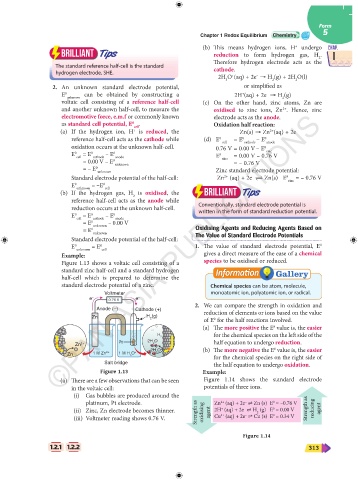
Figure 1.13 shows a voltaic cell consisting of a species to be oxidised or reduced.
standard zinc half-cell and a standard hydrogen
half-cell which is prepared to determine the
standard electrode potential of a zinc. Chemical species can be atom, molecule,
Voltmeter monoatomic ion, polyatomic ion, or radical.
e – 0.76 V e –
2. We can compare the strength in oxidation and
Anode (–) Cathode (+) reduction of elements or ions based on the value
Zn H (g) of E for the half reactions involved.
0
2
(a) The more positive the E value is, the easier
0
H for the chemical species on the left side of the
2
e – Zn 2+ Pt 2H O half equation to undergo reduction.
2
0
e – 2H O + e – (b) The more negative the E value is, the easier
Zn 1 M Zn 2+ 1 M H O + 3
for the chemical species on the right side of
3
Salt bridge the half equation to undergo oxidation.
Figure 1.13 Example:
(a) There are a few observations that can be seen Figure 1.14 shows the standard electrode
in the voltaic cell: potentials of three ions.
(i) Gas bubbles are produced around the
platinum, Pt electrode. Zn (aq) + 2e ⇌ Zn (s) E = –0.76 V
0
–
2+
0
–
+
(ii) Zinc, Zn electrode becomes thinner. Strength as oxidising agent 2H (aq) + 2e ⇌ H (g) E = 0.00 V Strength as reducing agent
2
2+
–
0
(iii) Voltmeter reading shows 0.76 V. Cu (aq) + 2e ⇌ Cu (s) E = 0.34 V
Figure 1.14
1.2.1 1.2.2 313

