


Page 348 - Cardiac Nursing
P. 348
1
                                   0:3
                                   1
                                /09
                                /09
                                   0:3
                                        M
                                          Pa
                                        M
                                     0 P
                                     0 P
                          q
                          q
                          q
                        32.
                        32.
                           xd
                              /29
                              /29
                             6
                           xd
                             6
                                          Pa
                                                  ara
                                                  ara
                                                  t
                                                 p
                                                  t
                                                   a
                                                      c.
                                                      c.
                                                    In
                                                   a
                                                    In
                                            e 3
                                            e 3
                                           g
                                           g
                                           g
                                              24
                                                 p
                                                 p
                                                A
                                              24
                                                A
                   p
                    30
            K34
                 15_
               0-c
                    30
                      0-3
                      0-3
         LWB K34 0-c 15_ p pp300-332.qxd  6/29/09  10:30 PM  Page 324 Aptara Inc.
         LWBK340-c15_
         LWB
                  324    P A R T  III / Assessment of Heart Disease
                                                            V
                                         Lead 11        Lead VV 1                                V 1        V 6
                                                    RA                       Normal
                 Normal P Wave
                                      RA        LA              LA
                 Right Atrial Enlargement                                    RVH
                 (p pulmonale)                       RA
                                      RA         LA
                                                                  LA
                                                      RA                     LVH
                 Left Atrial Enlargement  RA       LA
                 (p Mitrale)                                      LA
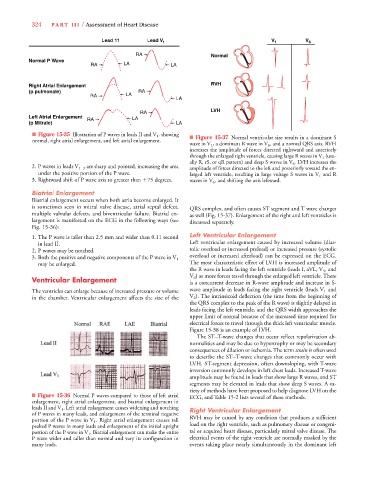
                   ■ Figure 15-35 Illustration of P waves in leads II and V 1 , showing  ■ Figure 15-37 Normal ventricular size results in a dominant S
                   normal, right atrial enlargement, and left atrial enlargement.
                                                                      wave in V 1 , a dominant R wave in V 6 , and a normal QRS axis. RVH
                                                                      increases the amplitude of forces directed rightward and anteriorly
                                                                      through the enlarged right ventricle, causing large R waves in V 1 (usu-
                                                                      ally R, rS, or qR pattern) and deep S waves in V 6 . LVH increases the
                  2. P waves in leads V 1–3 are sharp and pointed, increasing the area  amplitude of forces directed to the left and posteriorly toward the en-
                    under the positive portion of the P wave.         larged left ventricle, resulting in large voltage S waves in V 1 and R
                  3. Rightward shift of P wave axis to greater than
75 degrees.  waves in V 6 , and shifting the axis leftward.
                  Biatrial Enlargement
                  Biatrial enlargement occurs when both atria become enlarged. It
                  is sometimes seen in mitral valve disease, atrial septal defect,  QRS complex, and often causes ST segment and T wave changes
                  multiple valvular defects, and biventricular failure. Biatrial en-  as well (Fig. 15-37). Enlargement of the right and left ventricles is
                  largement is manifested on the ECG in the following ways (see  discussed separately.
                  Fig. 15-36):
                  1. The P wave is taller than 2.5 mm and wider than 0.11 second  Left Ventricular Enlargement
                    in lead II.                                       Left ventricular enlargement caused by increased volume (dias-
                  2. P waves may be notched.                          tolic overload or increased preload) or increased pressure (systolic
                                                                      overload or increased afterload) can be expressed on the ECG.
                  3. Both the positive and negative components of the P wave in V 1
                    may be enlarged.                                  The most characteristic effect of LVH is increased amplitude of
                                                                      the R wave in leads facing the left ventricle (leads I, aVL, V 5 , and
                                                                      V 6 ) as more forces travel through the enlarged left ventricle. There
                  Ventricular Enlargement                             is a concurrent decrease in R-wave amplitude and increase in S-
                  The ventricles can enlarge because of increased pressure or volume  wave amplitude in leads facing the right ventricle (leads V 1 and
                                                                      V
                  in the chamber. Ventricular enlargement affects the size of the  V 2 ). The intrinsicoid deflection (the time from the beginning of
                                                                      the QRS complex to the peak of the R wave) is slightly delayed in
                                                                      leads facing the left ventricle, and the QRS width approaches the
                                                                      upper limit of normal because of the increased time required for
                                                                      electrical forces to travel through the thick left ventricular muscle.
                                                                      Figure 15-38 is an example of LVH.
                                                                        The ST–T-wave changes that occur reflect repolarization ab-
                                                                      normalities and may be due to hypertrophy or may be secondary
                                                                      consequences of dilation or ischemia. The term strain is often used
                                                                      to describe the ST–T-wave changes that commonly occur with
                                                                      LVH. ST-segment depression, often downsloping, with T-wave
                                                                      inversion commonly develops in left chest leads. Increased T-wave
                                                                      amplitude may be found in leads that show large R waves, and ST
                                                                      segments may be elevated in leads that show deep S waves. A va-
                                                                      riety of methods have been proposed to help diagnose LVH on the
                  ■ Figure 15-36 Normal P waves compared to those of left atrial  ECG, and Table 15-2 lists several of these methods.
                  enlargement, right atrial enlargement, and biatrial enlargement in
                  leads II and V 1 . Left atrial enlargement causes widening and notching  Right Ventricular Enlargement
                  of P waves in many leads, and enlargement of the terminal negative
                  portion of the P wave in V 1 . Right atrial enlargement causes tall  RVH may be caused by any condition that produces a sufficient
                  peaked P waves in many leads and enlargement of the initial upright  load on the right ventricle, such as pulmonary disease or congeni-
                  portion of the P wave in V 1 . Biatrial enlargement can make the entire  tal or acquired heart disease, particularly mitral valve disease. The
                  P wave wider and taller than normal and vary its configuration in  electrical events of the right ventricle are normally masked by the
                  many leads.                                         events taking place nearly simultaneously in the dominant left

