


Page 350 - Cardiac Nursing
P. 350
0 P
0 P
0:3
1
0:3
Pa
g
Pa
M
M
1
xd
6
xd
q
q
/09
/09
/29
6
/29
ara
a
ara
t
t
c.
c.
In
a
In
p
e 3
26
e 3
g
g
p
p
A
26
A
LWB
LWB K34 0-c 15_ p p pp300-332.qxd 6/29/09 10:30 PM Page 326 Aptara Inc.
30
LWBK340-c15_
15_
0-c
K34
30
0-3
0-3
32.
q
32.
326 P A R T III / Assessment of Heart Disease
V
V
R
aVRR
aVR
V
R
V1
V4
V V
V4
V4
V1
I I I a a a aVR V1 1 1 V V 4 4
V
V
V
a a
aVL
L
V2
V2
V2
L
V2
V5
V V
II II II II aVL V V 2 2 V5 5 5
V V5
aVLVL
F
F
6
6
V6
V V
V6
I I I I II I I II II I I I aVF V3 V6
V3
V3
V3
V6
3
aVF
a a
aVFVF
3
V
V
V V
V
VI VI VI VI VI V V
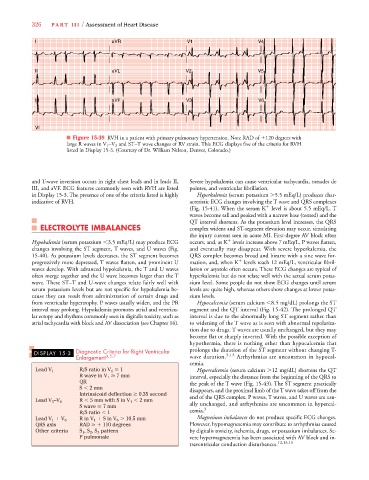
■ Figure 15-39 RVH in a patient with primary pulmonary hypertension. Note RAD of
120 degrees with
large R waves in V 1 –V 3 and ST–T wave changes of RV strain. This ECG displays five of the criteria for RVH
listed in Display 15-3. (Courtesy of Dr. William Nelson, Denver, Colorado.)
and T-wave inversion occurs in right chest leads and in leads II, Severe hypokalemia can cause ventricular tachycardia, torsades de
III, and aVF. ECG features commonly seen with RVH are listed pointes, and ventricular fibrillation.
in Display 15-3. The presence of one of the criteria listed is highly Hyperkalemia (serum potassium 5.5 mEq/L) produces char-
indicative of RVH. acteristic ECG changes involving the T wave and QRS complexes
(Fig. 15-41). When the serum K level is about 5.5 mEq/L, T
waves become tall and peaked with a narrow base (tented) and the
QT interval shortens. As the potassium level increases, the QRS
ELECTROLYTE IMBALANCES complex widens and ST-segment elevation may occur, simulating
the injury current seen in acute MI. First-degree AV block often
Hypokalemia (serum potassium 3.5 mEq/L) may produce ECG occurs, and, as K levels increase above 7 mEq/L, P waves flatten,
changes involving the ST segment, T waves, and U waves (Fig. and eventually may disappear. With severe hyperkalemia, the
15-40). As potassium levels decreases, the ST segment becomes QRS complex becomes broad and bizarre with a sine wave for-
progressively more depressed, T waves flatten, and prominent U mation, and, when K levels reach 12 mEq/L, ventricular fibril-
waves develop. With advanced hypokalemia, the T and U waves lation or asystole often occurs. These ECG changes are typical of
often merge together and the U wave becomes larger than the T hyperkalemia but do not relate well with the actual serum potas-
wave. These ST–T and U-wave changes relate fairly well with sium level. Some people do not show ECG changes until serum
serum potassium levels but are not specific for hypokalemia be- levels are quite high, whereas others show changes at lower potas-
cause they can result from administration of certain drugs and sium levels.
from ventricular hypertrophy. P waves usually widen, and the PR Hypocalcemia (serum calcium 8.5 mg/dL) prolongs the ST
interval may prolong. Hypokalemia promotes atrial and ventricu- segment and the QT interval (Fig. 15-42). The prolonged QT
lar ectopy and rhythms commonly seen in digitalis toxicity, such as interval is due to the abnormally long ST segment rather than
atrial tachycardia with block and AV dissociation (see Chapter 16). to widening of the T wave as is seen with abnormal repolariza-
tion due to drugs. T waves are usually unchanged, but they may
become flat or sharply inverted. With the possible exception of
hypothermia, there is nothing other than hypocalcemia that
DISPLAY 15-3 Diagnostic Criteria for Right Ventricular prolongs the duration of the ST segment without changing T-
3,12
Enlargement 3,5,7 wave duration. Arrhythmias are uncommon in hypocal-
cemia.
Lead V 1 R/S ratio in V 1 1 Hypercalcemia (serum calcium 12 mg/dL) shortens the QT
R wave in V 1 7 mm interval, especially the distance from the beginning of the QRS to
QR the peak of the T wave (Fig. 15-43). The ST segment practically
S 2 mm disappears, and the proximal limb of the T wave takes off from the
Intrinsicoid deflection 0.35 second end of the QRS complex. P waves, T waves, and U waves are usu-
Lead V 5 –V 6 R 5 mm with S in V 1 2 mm ally unchanged, and arrhythmias are uncommon in hypercal-
S wave 7 mm 3
R/S ratio 1 cemia.
Lead V 1
V 6 R in V 1
S in V 6 10.5 mm Magnesium imbalances do not produce specific ECG changes.
QRS axis RAD
110 degrees However, hypomagnesemia may contribute to arrhythmias caused
Other criteria S 1 , S 2 , S 3 pattern by digitalis toxicity, ischemia, drugs, or potassium imbalances. Se-
P pulmonale vere hypermagnesemia has been associated with AV block and in-
traventricular conduction disturbances. 12,13,15

