


Page 286 - ACCCN's Critical Care Nursing
P. 286
Cardiac Rhythm Assessment and Management  263


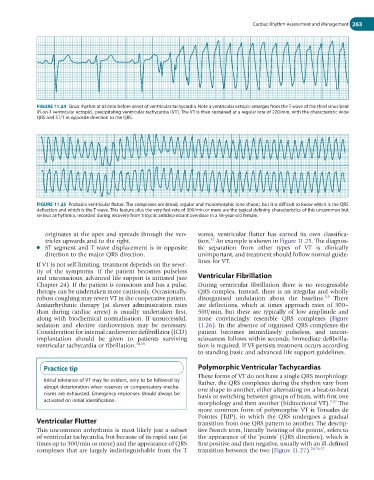
             FIGURE 11.24  Sinus rhythm at 65/min before onset of ventricular tachycardia. Note a ventricular ectopic emerges from the T wave of the third sinus beat
             (R-on-T ventricular ectopic), precipitating ventricular tachycardia (VT). The VT is then sustained at a regular rate of 220/min, with the characteristic wide
             QRS and ST/T in opposite direction to the QRS.


             FIGURE 11.25  Probable ventricular flutter. The complexes are broad, regular and monomorphic (one shape), but it is difficult to know which is the QRS
             deflection and which is the T wave. This feature plus the very fast rate of 300/min or more are the typical defining characteristics of this uncommon but
             serious arrhythmia, recorded during recovery from tricyclic antidepressant overdose in a 16-year-old female.


                originates at the apex and spreads through the ven-  waves,  ventricular  flutter  has  earned  its  own  classifica-
                tricles upwards and to the right.                 tion.  An example is shown in Figure 11.25. The diagnos-
                                                                      32
             ●  ST segment and T wave displacement is in opposite   tic  separation  from  other  types  of  VT  is  clinically
                direction to the major QRS direction.             unimportant, and treatment should follow normal guide-
                                                                  lines for VT.
             If VT is not self-limiting, treatment depends on the sever-
             ity  of  the  symptoms.  If  the  patient  becomes  pulseless
             and unconscious, advanced life support is initiated (see   Ventricular Fibrillation
             Chapter 24). If the patient is conscious and has a pulse,   During  ventricular  fibrillation  there  is  no  recognisable
             therapy can be undertaken more cautiously. Occasionally,   QRS complex. Instead, there is an irregular and wholly
                                                                                                           5,9
             robust coughing may revert VT in the cooperative patient.   disorganised  undulation  about  the  baseline.   There
             Antiarrhythmic  therapy  (at  slower  administration  rates   are  deflections,  which  at  times  approach  rates  of  300–
             than  during  cardiac  arrest)  is  usually  undertaken  first,   500/min,  but  these  are  typically  of  low  amplitude  and
             along  with  biochemical  normalisation.  If  unsuccessful,   none  convincingly  resemble  QRS  complexes  (Figure
             sedation  and  elective  cardioversion  may  be  necessary.   11.26). In the absence of organised QRS complexes the
             Consideration for internal cardioverter defibrillator (ICD)   patient  becomes  immediately  pulseless,  and  uncon-
             implantation  should  be  given  to  patients  surviving     sciousness follows within seconds. Immediate defibrilla-
             ventricular tachycardia or fibrillation. 34,35       tion is required. If VF persists treatment occurs according
                                                                  to standing basic and advanced life support guidelines.

               Practice tip                                       Polymorphic Ventricular Tachycardias
                                                                  These forms of VT do not have a single QRS morphology.
               Initial tolerance of VT may be evident, only to be followed by   Rather, the QRS complexes during the rhythm vary from
               abrupt deterioration when reserves or compensatory mecha-  one shape to another, either alternating on a beat-to-beat
               nisms are exhausted. Emergency responses should always be   basis or switching between groups of beats, with first one
               activated on initial identification.                                                          9,32
                                                                  morphology and then another (bidirectional VT).   The
                                                                  more common form of polymorphic VT is Torsades de
                                                                  Pointes  (TdP),  in  which  the  QRS  undergoes  a  gradual
             Ventricular Flutter                                  transition from one QRS pattern to another. The descrip-
             This uncommon arrhythmia is most likely just a subset   tive French term, literally ‘twisting of the points’, refers to
             of ventricular tachycardia, but because of its rapid rate (at   the appearance of the ‘points’ (QRS direction), which is
             times up to 300/min or more) and the appearance of QRS   first positive and then negative, usually with an ill-defined
             complexes that are largely indistinguishable from the T   transition between the two (Figure 11.27). 28,36,37

