


Page 288 - ACCCN's Critical Care Nursing
P. 288
Cardiac Rhythm Assessment and Management  265

                                                                  other  class  III  drugs  (e.g.  sotalol)  and  class  IA  agents,
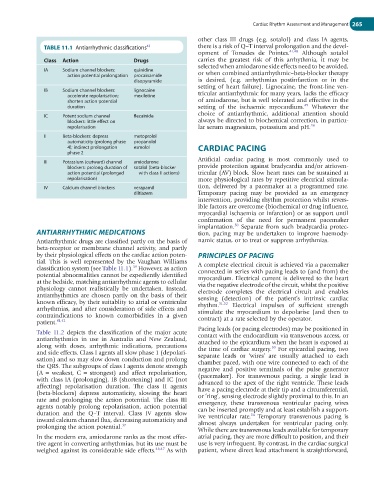
               TABLE 11.1  Antiarrhythmic classifications 43      there is a risk of Q–T interval prolongation and the devel-
                                                                  opment  of  Torsades  de  Pointes. 41,48   Although  sotalol
               Class  Action                 Drugs                carries  the  greatest  risk  of  this  arrhythmia,  it  may  be
                                                                  selected when amiodarone side effects need to be avoided,
               IA     Sodium channel blockers:   quinidine
                       action potential prolongation  procainamide  or when combined antiarrhythmic–beta-blocker therapy
                                             disopyramide         is  desired,  (e.g.  arrhythmias  postinfarction  or  in  the
                                                                  setting  of  heart  failure).  Lignocaine,  the  front-line  ven-
               IB     Sodium channel blockers:   lignocaine
                       accelerate repolarisation;   mexiletine    tricular antiarrhythmic for many years, lacks the efficacy
                       shorten action potential                   of amiodarone, but is well tolerated and effective in the
                                                                                                     49
                       duration                                   setting  of  the  ischaemic  myocardium.   Whatever  the
               IC     Potent sodium channel   flecainide          choice  of  antiarrhythmic,  additional  attention  should
                       blockers: little effect on                 always be directed to biochemical correction, in particu-
                       repolarisation                             lar serum magnesium, potassium and pH. 38
               II     Beta-blockers: depress   metoprolol
                       automaticity (prolong phase   propanolol
                       4); indirect prolongation   esmolol        CARDIAC PACING
                       phase 2
                                                                  Artificial  cardiac  pacing  is  most  commonly  used  to
               III    Potassium (outward) channel   amiodarone
                       blockers: prolong duration of   sotalol (beta-blocker   provide protection against bradycardia and/or atrioven-
                       action potential (prolonged   with class II actions)  tricular (AV) block. Slow heart rates can be sustained at
                       repolarisation)                            more physiological rates by repetitive electrical stimula-
               IV     Calcium channel blockers  verapamil         tion,  delivered  by  a  pacemaker  at  a  programmed  rate.
                                             diltiazem            Temporary  pacing  may  be  provided  as  an  emergency
                                                                  intervention, providing rhythm protection whilst revers-
                                                                  ible factors are overcome (biochemical or drug influence,
                                                                  myocardial ischaemia or infarction) or as support until
                                                                  confirmation  of  the  need  for  permanent  pacemaker
                                                                              50
                                                                  implantation.   Separate  from  such  bradycardia  protec-
             ANTIARRHYTHMIC MEDICATIONS                           tion,  pacing  may  be  undertaken  to  improve  haemody-
             Antiarrhythmic drugs are classified partly on the basis of   namic status, or to treat or suppress arrhythmias.
             beta-receptor or membrane channel activity, and partly
             by their physiological effects on the cardiac action poten-  PRINCIPLES OF PACING
             tial.  This  is  well  represented  by  the  Vaughan  Williams   A complete electrical circuit is achieved via a pacemaker
                                            39
             classification system (see Table 11.1).  However, as action   connected in series with pacing leads to (and from) the
             potential abnormalities cannot be expediently identified   myocardium. Electrical current is delivered to the heart
             at the bedside, matching antiarrhythmic agents to cellular   via the negative electrode of the circuit, whilst the positive
             physiology  cannot  realistically  be  undertaken.  Instead,   electrode  completes  the  electrical  circuit  and  enables
             antiarrhythmics  are  chosen  partly  on  the  basis  of  their   sensing  (detection)  of  the  patient’s  intrinsic  cardiac
             known efficacy, by their suitablity to atrial or ventricular   rhythm. 51,52   Electrical  impulses  of  sufficient  strength
             arrhythmias, and after consideration of side effects and   stimulate  the  myocardium  to  depolarise  (and  then  to
             contraindications  to  known  comorbidities  in  a  given   contract) at a rate selected by the operator.
             patient. 41,42
                                                                  Pacing leads (or pacing electrodes) may be positioned in
             Table  11.2  depicts  the  classification  of  the  major  acute
             antiarrhythmics  in  use  in  Australia  and  New  Zealand,   contact with the endocardium via transvenous access, or
             along  with  doses,  arrhythmic  indications,  precautions   attached to the epicardium when the heart is exposed at
                                                                                          53
             and side effects. Class I agents all slow phase 1 (depolari-  the time of cardiac surgery.  For epicardial pacing, two
             sation) and so may slow down conduction and prolong   separate  leads  or  ‘wires’  are  usually  attached  to  each
             the QRS. The subgroups of class I agents denote strength   chamber paced, with one wire connected to each of the
             (A  =  weakest,  C  =  strongest)  and  affect  repolarisation,   negative  and  positive  terminals  of  the  pulse  generator
             with class IA (prolonging), IB (shortening) and IC (not   (pacemaker).  For  transvenous  pacing,  a  single  lead  is
             affecting)  repolarisation  duration.  The  class  II  agents   advanced to the apex of the right ventricle. These leads
             (beta-blockers)  depress  automaticity,  slowing  the  heart   have a pacing electrode at their tip and a circumferential,
             rate  and  prolonging  the  action  potential.  The  class  III   or ‘ring’, sensing electrode slightly proximal to this. In an
             agents  notably  prolong  repolarisation,  action  potential   emergency,  these  transvenous  ventricular  pacing  wires
             duration  and  the  Q–T  interval.  Class  IV  agents  slow   can be inserted promptly and at least establish a support-
                                                                                   54
             inward calcium channel flux, decreasing automaticity and   ive  ventricular  rate.   Temporary  transvenous  pacing  is
             prolonging the action potential. 37                  almost  always  undertaken  for  ventricular  pacing  only.
                                                                  While there are transvenous leads available for temporary
             In the modern era, amiodarone ranks as the most effec-  atrial pacing, they are more difficult to position, and their
             tive agent in converting arrhythmias, but its use must be   use is very infrequent. By contrast, in the cardiac surgical
             weighed against its considerable side effects. 46,47  As with   patient, where direct lead attachment is straightforward,

