


Page 290 - ACCCN's Critical Care Nursing
P. 290
Cardiac Rhythm Assessment and Management  267


               TABLE 11.3  Pacemaker controls and settings

               Control             Function
               Base rate           Sets the rate at which the pacemaker will discharge: pacing occurs at this rate unless the patient’s own rate is faster
                                     and is sensed by the pacemaker. Typically set at 60–100/min.
               Ventricular output  The size, or strength, of the stimulus delivered to the ventricles. In temporary devices this is an adjustable current
                                     (measured in milliamperes [mA]). Output is increased until capture (successful stimulation) is achieved. The
                                     minimum current required to achieve capture is termed the output threshold. Impulses delivered below the
                                     threshold value will not capture the myocardium. Temporary pacemakers have an adjustable output range of
                                     0.1–25 mA.
               Atrial output       The size or strength of the stimulus delivered to the atria. Range 0.1 to 20 mA.
               Atrial and ventricular   Not adjustable on all devices. Allows adjustment of the duration for which the pacemaker output is applied to the
                 pulse width         myocardium. Selectable range typically 1.0–2.0 milliseconds (msec) in 0.25 msec increments. Increasing the pulse
                                     width enhances ability to gain capture.
               Atrioventricular delay  The interval between the delivery of the atrial and ventricular pacing stimuli. Normally this is set in the same range
                                     as normal P–R intervals (between 0.12 and 0.20 sec).
               Sensitivity         Affects the ability of the pacemaker to detect the presence of spontaneous cardiac activity. Sensitivity settings can
                                     be adjusted between 1.0 and 20 millivolts (mV). Set at 1.0 mV the device is very sensitive (able to sense small
                                     electrical signals from the heart). Set at higher values, the device becomes less sensitive (higher voltage signals
                                     required to be detected), with the risk that QRS complexes or P waves will not be sensed.


               TABLE 11.4  Pacemaker terminology 56

                                                                                                Antitachyarrhythmia
               Chamber paced     Chamber sensed   Response to sensing  Programmable functions   functions
               O, none           O, none          O, none              O, none                  O, none
               A, atrium         A, atrium        T, triggered         P, simple programmable   P, pacing
               V, ventricle      V, ventricle     I, inhibited         M, multi-programmable    S, shock
               D, dual (A & V)   D, dual (A & V)  D, dual (T & I)      C, communicating         D, dual (P & S)
                                                                       R, rate modulation


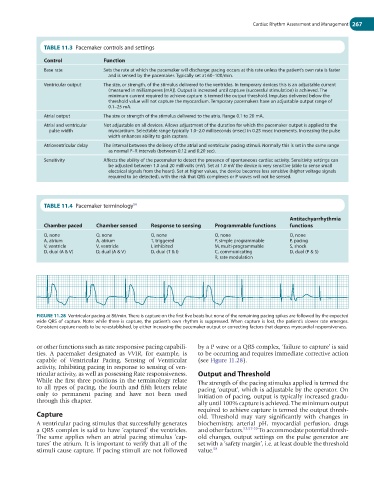
             FIGURE 11.28  Ventricular pacing at 86/min. There is capture on the first five beats but none of the remaining pacing spikes are followed by the expected
             wide  QRS  of  capture.  Note:  while  there  is  capture,  the  patient’s  own  rhythm  is  suppressed. When  capture  is  lost,  the  patient’s  slower  rate  emerges.
             Consistent capture needs to be re-established, by either increasing the pacemaker output or correcting factors that depress myocardial responsiveness.


             or other functions such as rate responsive pacing capabili-  by a P wave or a QRS complex, ‘failure to capture’ is said
             ties.  A  pacemaker  designated  as  VVIR,  for  example,  is   to be occurring and requires immediate corrective action
             capable  of  Ventricular  Pacing,  Sensing  of  Ventricular   (see Figure 11.28).
             activity, Inhibiting pacing in response to sensing of ven-
             tricular activity, as well as possessing Rate responsiveness.   Output and Threshold
             While the first three positions in the terminology relate   The strength of the pacing stimulus applied is termed the
             to all types of pacing, the fourth and fifth letters relate   pacing ‘output’, which is adjustable by the operator. On
             only  to  permanent  pacing  and  have  not  been  used   initiation of pacing, output is typically increased gradu-
             through this chapter.                                ally until 100% capture is achieved. The minimum output
                                                                  required to achieve capture is termed the output thresh-
             Capture                                              old.  Threshold  may  vary  significantly  with  changes  in
             A ventricular pacing stimulus that successfully generates   biochemistry,  arterial  pH,  myocardial  perfusion,  drugs
             a QRS complex is said to have ‘captured’ the ventricles.   and other factors. 53,57-59  To accommodate potential thresh-
             The  same  applies  when  an  atrial  pacing  stimulus  ‘cap-  old changes, output settings on the pulse generator are
             tures’ the atrium. It is important to verify that all of the   set with a ‘safety margin’, i.e. at least double the threshold
             stimuli cause capture. If pacing stimuli are not followed   value. 58

