


Page 291 - ACCCN's Critical Care Nursing
P. 291
268  P R I N C I P L E S   A N D   P R A C T I C E   O F   C R I T I C A L   C A R E


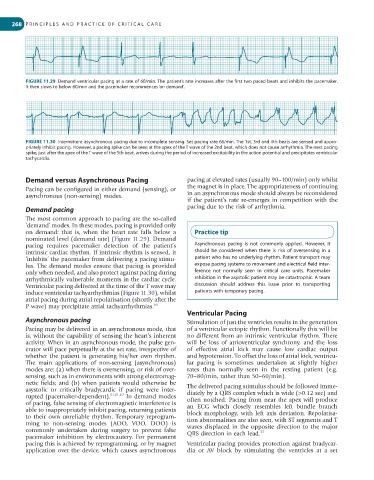
         FIGURE 11.29  Demand ventricular pacing at a rate of 60/min. The patient’s rate increases after the first two paced beats and inhibits the pacemaker.
         It then slows to below 60/min and the pacemaker recommences ‘on demand’.


         FIGURE 11.30  Intermittent asynchronous pacing due to incomplete sensing. Set pacing rate 66/min. The 1st, 3rd and 4th beats are sensed and appro-
         priately inhibit pacing. However, a pacing spike can be seen at the apex of the T wave of the 2nd beat, which does not cause arrhythmia. The next pacing
         spike, just after the apex of the T wave of the 5th beat, arrives during the period of increased excitability in the action potential and precipitates ventricular
         tachycardia.


         Demand versus Asynchronous Pacing                    pacing at elevated rates (usually 90–100/min) only whilst
         Pacing can be configured in either demand (sensing), or   the magnet is in place. The appropriateness of continuing
         asynchronous (non-sensing) modes.                    in an asynchronous mode should always be reconsidered
                                                              if the patient’s rate re-emerges in competition with the
         Demand pacing                                        pacing due to the risk of arrhythmia.
         The most common approach to pacing are the so-called
         ‘demand’ modes. In these modes, pacing is provided only
         on  demand:  that  is,  when  the  heart  rate  falls  below  a   Practice tip
         nominated level (demand rate) (Figure 11.29). Demand
         pacing  requires  pacemaker  detection  of  the  patient’s   Asynchronous  pacing  is  not  commonly  applied.  However,  it
         intrinsic cardiac rhythm. If intrinsic rhythm is sensed, it   should  be  considered  when  there  is  risk  of  oversensing  in  a
         ‘inhibits’ the pacemaker from delivering a pacing stimu-  patient who has no underlying rhythm. Patient transport may
         lus. The demand modes ensure that pacing is provided    expose pacing systems to movement and electrical field inter-
         only when needed, and also protect against pacing during   ference  not  normally  seen  in  critical  care  units.  Pacemaker
         arrhythmically vulnerable moments in the cardiac cycle.   inhibition in the asystolic patient may be catastrophic. A team
         Ventricular pacing delivered at the time of the T wave may   discussion  should  address  this  issue  prior  to  transporting
         induce ventricular tachyarrhythmias (Figure 11.30), whilst   patients with temporary pacing.
         atrial pacing during atrial repolarisation (shortly after the
         P wave) may precipitate atrial tachyarrhythmias. 60
                                                              Ventricular Pacing
         Asynchronous pacing                                  Stimulation of just the ventricles results in the generation
         Pacing may be delivered in an asynchronous mode, that   of a ventricular ectopic rhythm. Functionally this will be
         is, without the capability of sensing the heart’s inherent   no different from an intrinsic ventricular rhythm. There
         activity. When in an asynchronous mode, the pulse gen-  will  be  loss  of  atrioventricular  synchrony,  and  the  loss
         erator will pace perpetually at the set rate, irrespective of   of  effective  atrial  kick  may  cause  low  cardiac  output
         whether  the  patient  is  generating  his/her  own  rhythm.   and hypotension. To offset the loss of atrial kick, ventricu-
         The  main  applications  of  non-sensing  (asynchronous)   lar  pacing  is  sometimes  undertaken  at  slightly  higher
         modes are: (a) when there is oversensing, or risk of over-  rates  than  normally  seen  in  the  resting  patient  (e.g.
         sensing, such as in environments with strong electromag-  70–80/min, rather than 50–60/min).
         netic fields; and (b) when patients would otherwise be   The delivered pacing stimulus should be followed imme-
         asystolic  or  critically  bradycardic  if  pacing  were  inter-  diately by a QRS complex which is wide (>0.12 sec) and
         rupted (pacemaker-dependent). 51,61,62  In demand modes   often notched. Pacing from near the apex will produce
         of pacing, false sensing of electromagnetic interference is   an  ECG  which  closely  resembles  left  bundle  branch
         able to inappropriately inhibit pacing, returning patients   block  morphology,  with  left  axis  deviation.  Repolarisa-
         to  their  own  unreliable  rhythm.  Temporary  reprogram-  tion abnormalities are also seen, with ST segments and T
         ming  to  non-sensing  modes  (AOO,  VOO,  DOO)  is     waves  displaced  in  the  opposite  direction  to  the  major
         commonly  undertaken  during  surgery  to  prevent  false   QRS direction in each lead. 57
         pacemaker  inhibition  by  electrocautery.  For  permanent
         pacing this is achieved by reprogramming, or by magnet   Ventricular pacing provides protection against bradycar-
         application over the device, which causes asynchronous   dia  or  AV  block  by  stimulating  the  ventricles  at  a  set

