


Page 911 - Hematology_ Basic Principles and Practice ( PDFDrive )
P. 911
794    Part VII  Hematologic Malignancies


          TABLE   Recurrent Chromosomal Abnormalities in Primary
          56.4    Myelodysplastic Syndrome
         Abnormality               Frequency (%)
         −5 or del 5q                 10–15
         −7 or del 7q                 10
            trisomy 8                 10–17
            i(17q) or t(17p)           2–3
            del(12p) or t(12p)         1–2
            del(11q)                   1–2
         −13 or del(13q)               1–2
         del(9q)                       1–2
            idic(X)                    1
            inv(3)(q21q26.2)           1
            t(6;9)(p23;q34)            1
            t(3;21)(q26.2;q22.1)      <1
            t(1;3)(p36.3;q21.2)       <1
            t(11;16)(q23;p13.3)       <1
            t(2;11) (p21;q23)         <1
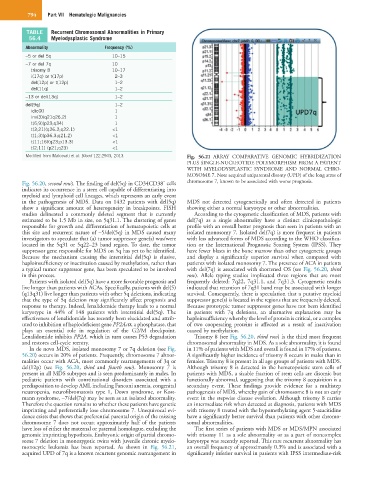
         Modified from Malcovati et al: Blood 122:2943, 2013.  Fig.  56.21  ARRAY  COMPARATIVE  GENOMIC  HYBRIDIZATION
                                                              PLUS SINGLE-NUCLEOTIDE POLYMORPHISM FROM A PATIENT
                                                              WITH  MYELODYSPLASTIC  SYNDROME  AND  NORMAL  CHRO-
                                                              MOSOME 7. Note acquired uniparental disomy (UPD) of the long arms of
                                                      −
        Fig. 56.20, second row). The finding of del(5q) in CD34CD38  cells   chromosome 7, known to be associated with worse prognosis.
        indicates its occurrence in a stem cell capable of differentiating into
        myeloid and lymphoid cell lineages, which represents an early event
        in the pathogenesis of MDS. Data on 1432 patients with del(5q)   MDS  not  detected  cytogenetically  and  often  detected  in  patients
        show  a  significant  amount  of  heterogeneity  in  breakpoints.  FISH   showing either a normal karyotype or other abnormalities.
        studies  delineated  a  commonly  deleted  segment  that  is  currently   According to the cytogenetic classification of MDS, patients with
        estimated to be 1.5 Mb in size, on 5q31.1. The clustering of genes   del(7q)  as  a  single  abnormality  have  a  distinct  clinicopathologic
        responsible for growth and differentiation of hematopoietic cells at   profile with an overall better prognosis than seen in patients with an
        this site and recurrent nature of −5/del(5q) in MDS caused many   isolated monosomy 7. Isolated del(7q) is more frequent in patients
        investigators to speculate that (a) tumor suppressor gene(s) was/were   with less advanced forms of MDS according to the WHO classifica-
        located in the 5q31 or 5q22–23 band region. To date, the tumor   tion  or  the  International  Prognostic  Scoring  System  (IPSS). They
        suppressor gene responsible for MDS on 5q has yet to be identified.   have fewer blasts in the bone marrow than other cytogenetic groups
        Because  the  mechanism  causing  the  interstitial  del(5q)  is  elusive,   and  display  a  significantly  superior  survival  when  compared  with
        haploinsufficiency or inactivation caused by methylation, rather than   patients with isolated monosomy 7. The presence of ACA in patients
        a typical tumor suppressor gene, has been speculated to be involved   with del(7q) is associated with shortened OS (see Fig. 56.20, third
        in this process.                                      row).  Allele  typing  studies  implicated  three  regions  that  are  most
           Patients with isolated del(5q) have a more favorable prognosis and   frequently  deleted:  7q22,  7q31.1,  and  7q31.3.  Cytogenetic  results
        live longer than patients with ACAs. Specifically, patients with del(5)  indicated that retention of 7q31 band may be associated with longer
        (q13q31) live longer than patients with other 5q deletions, indicating   survival. Consequently, there is speculation that a putative myeloid
        that the type of 5q deletion may significantly affect prognosis and   suppressor gene(s) is located in the regions that are frequently deleted.
        response to therapy. Indeed, lenalidomide therapy leads to a normal   Because prototypic tumor suppressor genes have not been identified
        karyotype  in  44%  of  148  patients  with  interstitial  del(5q).  The   in  patients  with  7q  deletions,  an  alternative  explanation  may  be
        effectiveness of lenalidomide has recently been elucidated and attrib-  haploinsufficiency whereby the level of protein is critical, or a complex
        uted to inhibition of haplodeficient gene PP2Acα, a phosphatase, that   of  two  cooperating  proteins  is  affected  as  a  result  of  inactivation
        plays  an  essential  role  in  regulation  of  the  G2/M  checkpoint.   caused by methylation.
        Lenalidomide inhibits PP2A, which in turn causes P53 degradation   Trisomy 8 (see Fig. 56.20, third row) is the third most frequent
        and restores cell-cycle reentry.                      chromosomal abnormality in MDS. As a sole abnormality, it is found
           In de novo MDS, isolated monosomy 7 or 7q deletion (see Fig.   in 11% of patients with MDS and overall is found in 17% of patients.
        56.20) occurs in 20% of patients. Frequently, chromosome 7 abnor-  A significantly higher incidence of trisomy 8 occurs in males than in
        malities occur with ACA, most commonly rearrangements of 3q or   females. Trisomy 8 is present in all age groups of patients with MDS.
        del(12p)  (see  Fig.  56.20,  third  and  fourth  row).  Monosomy  7  is   Although trisomy 8 is detected in the hematopoietic stem cells of
        present in all MDS subtypes and is seen predominantly in males. In   patients with MDS, a sizable fraction of stem cells are disomic but
        pediatric  patients  with  constitutional  disorders  associated  with  a   functionally abnormal, suggesting that the trisomy 8 acquisition is a
        predisposition to develop AML including Fanconi anemia, congenital   secondary  event.  These  findings  provide  evidence  for  a  multistep
        neutropenia,  neurofibromatosis  type  1,  Down  syndrome,  or  Kost-  pathogenesis of MDS, whereby gain of chromosome 8 is not an early
        mann syndrome, −7/del(7q) may be seen as an isolated abnormality.   event in the stepwise disease evolution. Although trisomy 8 carries
        Therefore the question remains to whether these patients have genetic   an intermediate risk when detected at diagnosis, patients with MDS
        imprinting and preferentially lose chromosome 7. Unequivocal evi-  with trisomy 8 treated with the hypomethylating agent 5-azacitidine
        dence exists that shows that preferential parental origin of the missing   have a significantly better survival than patients with other chromo-
        chromosome  7  does  not  occur;  approximately  half  of  the  patients   somal abnormalities.
        have loss of either the maternal or paternal homologue, excluding the   The first series of patients with MDS or MDS/MPN associated
        genomic imprinting hypothesis. Embryonic origin of partial chromo-  with trisomy 11 as a sole abnormality or as a part of noncomplex
        some 7 deletion in monozygotic twins with juvenile chronic myelo-  karyotype was recently reported. This rare recurrent abnormality has
        monocytic  leukemia  has  been  reported.  As  shown  in  Fig.  56.21,   an overall frequency of approximately 0.3% and is associated with a
        acquired UPD of 7q is a known recurrent genomic rearrangement in   significantly inferior survival in patients with IPSS intermediate-risk

