


Page 912 - Hematology_ Basic Principles and Practice ( PDFDrive )
P. 912
Chapter 56  Conventional and Molecular Cytogenomic Basis of Hematologic Malignancies  795


            disease (p = .0002) but comparable to the poor-risk group (p = .97).   at approximately 70.9 Mb (five cases) and 72.1 Mb (seven cases) on
            Trisomy 11 is associated with clinical aggressiveness and represents a   the X chromosome. None of the 11 breakpoints occurred in a gene,
            high-risk cytogenetic abnormality.                    strongly indicating that the idic(X)(q13) does not result in a fusion
              Deletions  of  17p  are  seen  in  3%  to  4%  of  MDS  and  AML   gene. Instead, the functional outcome of the abnormality confers a
            patients.  These  patients  often  display  several  other  chromosomal   gene dosage effect because of the concurrent gain of Xpter-q13 and
            rearrangements, including monosomy 17, isochromosome 17q (see   loss of Xq13-qter. This region of the X chromosome is enriched for
            Fig. 56.20, third row), and unbalanced translocations between chro-  repeated sequences and most likely, these repeats may facilitate the
            mosome 17 and another chromosome. Approximately 30% of these   formation of idic(X). The isodicentric X chromosome was inactive in
            deletions are related to therapy. The extent of 17p deletion in all cases   some patients and active in other patients; hence idic(X) appears to
            involves  the  TP53  gene.  There  appears  to  be  a  close  correlation   be leukemogenic regardless of X a or X i  involvement.
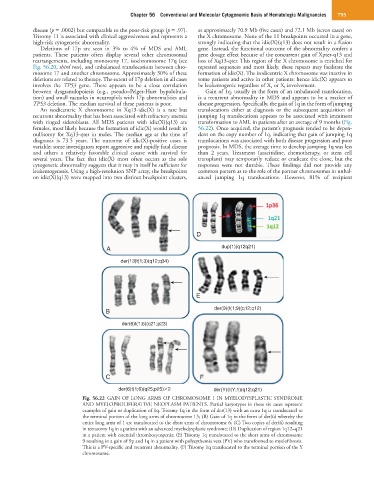
            between  dysgranulopoiesis  (e.g.,  pseudo–Pelger-Huet  hypolobula-  Gain of 1q, usually in the form of an unbalanced translocation,
            tion) and small vacuoles in neutrophils with 17p abnormalities and   is a recurrent abnormality in MDS and appears to be a marker of
            TP53 deletion. The median survival of these patients is poor.  disease progression. Specifically, the gain of 1q in the form of jumping
              An  isodicentric  X  chromosome  in  Xq13-idic(X)  is  a  rare  but   translocations  either  at  diagnosis  or  the  subsequent  acquisition  of
            recurrent abnormality that has been associated with refractory anemia   jumping 1q translocations appears to be associated with imminent
            with  ringed  sideroblasts.  All  MDS  patients  with  idic(X)(q13)  are   transformation to AML in patients after an average of 9 months (Fig.
            females, most likely because the formation of idic(X) would result in   56.22). Once acquired, the patient’s prognosis tended to be depen-
            nullisomy for Xq13-qter in males. The median age at the time of   dent on the copy number of 1q, indicating that gain of jumping 1q
            diagnosis  is  73.5  years.  The  outcome  of  idic(X)-positive  cases  is   translocations was associated with both disease progression and poor
            variable; some investigators report aggressive and rapidly fatal disease   prognosis. In MDS, the average time to develop jumping 1q was less
            and  others  a  relatively  favorable  clinical  course  with  survival  for   than  2  years.  Treatment  (azacitidine,  chemotherapy,  or  stem  cell
            several  years.  The  fact  that  idic(X)  most  often  occurs  as  the  sole   transplant) may temporarily reduce or eradicate the clone, but the
            cytogenetic abnormality suggests that it may in itself be sufficient for   responses  were  not  durable.  These  findings  did  not  provide  any
            leukemogenesis. Using a high-resolution SNP array, the breakpoints   common pattern as to the role of the partner chromosomes in unbal-
            on idic(X)(q13) were mapped into two distinct breakpoint clusters,   anced  jumping  1q  translocations.  However,  81%  of  recipient


                                                                 D

                                    A                                     dup(1)(q12q21)

                                         der(13)t(1;3)(q12;q34)


                                                                 E
                                                                       der(9)(t(1;9)(q12;q12)
                                    B
                                         der(6)t(1;6)(q21;p23)


                                    C                             F

                                        der(6)t(1;6)(q25;p25) 2        der(Y)(t(Y;1)(q12;q21)
                            Fig. 56.22  GAIN OF LONG ARMS OF CHROMOSOME 1 IN MYELODYSPLASTIC SYNDROME
                            AND MYELOPROLIFERATIVE NEOPLASM PATIENTS. Partial karyotypes in these six cases represent
                            examples of gain or duplication of 1q. Trisomy 1q in the form of der(13) with an extra 1q is translocated to
                            the terminal portion of the long arms of chromosome 13; (B) Gain of 1q in the form of der(6) whereby the
                            entire long arms of 1 are translocated to the short arms of chromosome 6; (C) Two copies of der(6) resulting
                            in tetrasomy 1q in a patient with an advanced myelodysplastic syndrome; (D) Duplication of region 1q12–q21
                            in a patient with essential thrombocytopenia; (E) Trisomy 1q translocated to the short arms of chromosome
                            9 resulting in a gain of 9p and 1q in a patient with polycythemia vera (PV) who transformed to myelofibrosis.
                            This is a PV-specific and recurrent abnormality. (F) Trisomy 1q translocated to the terminal portion of the Y
                            chromosome.

