


Page 913 - Hematology_ Basic Principles and Practice ( PDFDrive )
P. 913
796    Part VII  Hematologic Malignancies


                                                              genes, indicating the importance of mutations residing outside the
             t(3;3)(q21;q26)
                                                              coding exome.
                                                                 A  monosomal  karyotype  (MK),  a  new  cytogenetic  category,  is
                                                              defined  as  a  karyotype  showing  two  or  more  distinct  autosomal
                                                              chromosome  monosomies  or  one  single  autosomal  monosomy
                                                              (excluding  isolated  loss  of  X  or Y)  in  the  presence  of  a  structural
                                                              abnormality (see Fig. 56.20, bottom row). Initial reports indicated that
                                                              the MK in MDS, with or without monosomy for chromosomes 5
                                                              and  7,  was  prognostically  worse  than  other  complex  karyotypes,
                                                              although  later  reports  could not  confirm  these  results. The  reason
                                                              may be that treatment with azacitidine may have reduced the negative
                              der(3)del(3)(q11.2q13)inv(3)(p21q21.1)  impact of MK in high-risk patients with MDS.
        A                   B                                    The clinical significance of loss of the Y chromosome, observed
                                                              in 10% of patients with MDS and approximately 7% of older adult
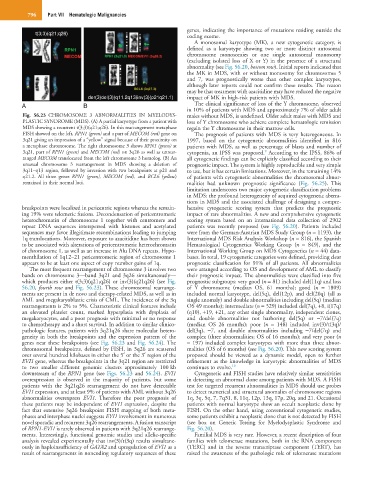
        Fig.  56.23  CHROMOSOME  3  ABNORMALITIES  IN  MYELODYS-  males without MDS, is undefined. Older adult males with MDS and
        PLASTIC SYNDROME (MDS). (A) A partial karyotype from a patient with   loss of Y chromosome who achieve complete hematologic remission
        MDS showing a recurrent t(3;3)(q21;q26). In this rearrangement metaphase   regain the Y chromosome in their marrow cells.
        FISH showed on the left, RPN1 (green) and a part of MECOM (red) gene on   The prognosis of patients with MDS is very heterogeneous. In
        3q21 giving an impression of a “yellow” signal because of their proximity on   1997,  based  on  the  cytogenetic  abnormalities  identified  in  816
        a metaphase chromosome. The right chromosome 3 shows RPN1 (green) at   patients with MDS, as well as percentage of blasts and number of
        3q21, part of RPN1 (green) and MECOM (red) on 3q26 as well as unrear-  cytopenia, an IPSS was proposed.  According to the IPSS, 86% of
                                                                                        9
        ranged MECOM translocated from the left chromosome 3 homolog. (B) An   all cytogenetic findings can be explicitly classified according to their
        unusual  chromosome  3  rearrangement  in  MDS  showing  a  deletion  of   prognostic impact. The system is highly reproducible and very simple
        3q11–q13 region, followed by inversion with two breakpoints at p21 and   to use, but it has certain limitations. Moreover, in the remaining 14%
        q21.2.  All  three  genes  RPN1  (green),  MECOM  (red),  and  BCL6  (yellow)   of patients with cytogenetic abnormalities the chromosomal abnor-
        remained in their normal loci.                        malities  had  unknown  prognostic  significance  (Fig.  56.25).  This
                                                              limitation underscores two major cytogenetic classification problems
                                                              in MDS: the profound heterogeneity of acquired cytogenetic aberra-
                                                              tions in MDS and the associated challenge of designing a compre-
        breakpoints were localized in pericentric regions whereas the remain-  hensive  cytogenetic  scoring  system  that  predicts  the  prognostic
        ing 19% were telomeric fusions. Decondensation of pericentromeric   impact of rare abnormalities. A new and comprehensive cytogenetic
        heterochromatin  of  chromosome  1  together  with  centromere  and   scoring  system  based  on  an  international  data  collection  of  2902
        repeat  DNA  sequences  interspersed  with  histones  and  acetylated   patients  was  recently  proposed  (see  Fig.  56.20).  Patients  included
        sequences may favor illegitimate recombinations leading to jumping   were from the German-Austrian MDS Study Group (n = 1193), the
        1q translocations. Moreover, exposure to azacitidine has been shown   International MDS Risk Analysis Workshop (n = 816), the Spanish
        to be associated with alterations of pericentromeric heterochromatin   Hematological  Cytogenetics  Working  Group  (n  =  849),  and  the
        of chromosome 1, as well as an increase in Alu DNA repeats. Hypo-  International Working Group on MDS Cytogenetics (n = 44) data-
        menthilation of 1q12–21 pericentromeric region of chromosome 1   bases. In total, 19 cytogenetic categories were defined, providing clear
        appears to be at least one aspect of copy number gains of 1q.  prognostic  classification  for  91%  of  all  patients.  All  abnormalities
           The most frequent rearrangement of chromosome 3 involves two   were arranged according to OS and development of AML to classify
        bands on chromosome 3—band 3q21 and 3q26 simultaneously—  their prognostic impact. The abnormalities were classified into five
        which produces either t(3;3)(q21;q26) or inv(3)(q21q26) (see Fig.   prognostic subgroups: very good (n = 81) included del(11q) and loss
        56.20,  fourth  row  and  Fig.  56.23). These  chromosomal  rearrange-  of  Y  chromosome  (median  OS,  61  months);  good  (n  =  1809)
        ments are present in de novo and therapy-related MDS, as well as in   included normal karyotype, del(5q), del(12p), and del(20q) (all as
        AML and megakaryoblastic crisis of CML. The incidence of the 3q   single anomaly) and double abnormalities including del(5q) (median
        rearrangements is 2% to 5%. Characteristic clinical features include   OS 49 months); intermediate (n = 529) included del(7q), +8, i(17q)
        an  elevated  platelet  count,  marked  hyperplasia  with  dysplasia  of   (q10), +19, +21, any other single abnormality, independent clones,
        megakaryocytes, and a poor prognosis with minimal or no response   and  double  abnormalities  not  harboring  del(5q)  or  −7/del(7q)
        to chemotherapy and a short survival. In addition to similar clinico-  (median  OS  26  months);  poor  (n  =  148)  included  inv(3)/t(3q)/
        pathologic features, patients with 3q21q26 share molecular hetero-  del(3q),  −7,  and  double  abnormalities  including  −7/del(7q)  and
        geneity  in  both  the  breakpoints  and  the  expression  pattern  of  the   complex (three abnormalities; OS of 16 months); and very poor (n
        genes near these breakpoints (see Fig. 56.23 and Fig. 56.24). The   = 197) included complex karyotypes with more than three abnor-
        chromosomal breakpoints, defined by FISH, in 3q26 are scattered   malities (OS of 6 months) (see Fig. 56.20). This new scoring system
        over several hundred kilobases in either the 5′ or the 3′ region of the   proposed  should  be  viewed  as  a  dynamic  model,  open  to  further
        EVI1 gene, whereas the breakpoints in the 3q21 region are restricted   refinement  as  the  knowledge  in  karyotypic  abnormalities  of  MDS
        to  two  smaller  different  genomic  clusters  approximately  100 kb   continues to evolve. 10
        downstream of the RPN1 gene (see Figs. 56.23 and 56.24). EVI1   Cytogenetic and FISH studies have relatively similar sensitivities
        overexpression  is  observed  in  the  majority  of  patients,  but  some   in detecting an abnormal clone among patients with MDS. A FISH
        patients  with  the  3q21q26  rearrangement  do  not  have  detectable   test for targeted recurrent abnormalities in MDS should use probes
        EVI1 expression, and at least 9% of patients with AML without 3q26   to detect numerical and structural anomalies of chromosome regions
        abnormalities  overexpress  EVI1.  Therefore  the  poor  prognosis  of   1q, 3q, 5q, 7, 7q31, 8, 11q, 12p, 13q, 17p, 20q, and 21. Occasional
        these patients may be independent of EVI1 expression, despite the   patients with normal karyotype show an occult neoplastic clone by
        fact that extensive 3q26 breakpoint FISH mapping of both meta-  FISH. On the other hand, using conventional cytogenetic studies,
        phases and interphase nuclei suggests EVI1 involvement in numerous   some patients exhibit a neoplastic clone that is not detected by FISH
        novel sporadic and recurrent 3q26 rearrangements. A fusion transcript   (see  box  on  Genetic  Testing  for  Myelodysplastic  Syndrome  and
        of RPN1-EVI1 is rarely observed in patients with 3q21q26 rearrange-  Fig. 56.20).
        ments. Interestingly, functional genomic studies and allelic-specific   Familial MDS is very rare. However, a recent description of four
        analysis revealed experimentally that inv(3)/t(3q) results simultane-  families  with  telomerase  mutations,  both  in  the  RNA  component
        ously in haploinsufficiency of GATA2 and upregulation of EVI1 as a   (TERC)  and  in  the  reverse  transcriptase  component  (TERT),  has
        result of rearrangements in noncoding regulatory sequences of these   raised the awareness of the pathologic role of telomerase mutations

