


Page 445 - Textbook of Pathology, 6th Edition
P. 445
429


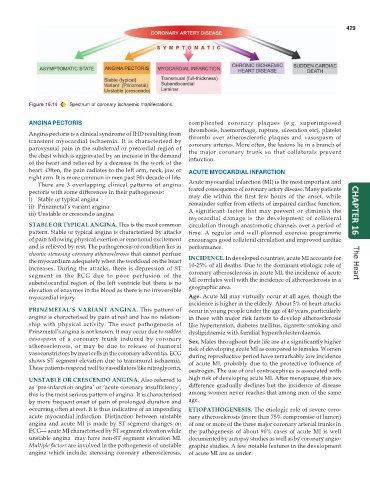
           Figure 16.14  Spectrum of coronary ischaemic manifestations.


           ANGINA PECTORIS                                     complicated coronary plaques (e.g. superimposed
                                                               thrombosis, haemorrhage, rupture, ulceration etc), platelet
           Angina pectoris is a clinical syndrome of IHD resulting from  thrombi over atherosclerotic plaques and vasospasm of
           transient myocardial ischaemia. It is characterised by  coronary arteries. More often, the lesions lie in a branch of
           paroxysmal pain in the substernal or precordial region of  the major coronary trunk so that collaterals prevent
           the chest which is aggravated by an increase in the demand  infarction.
           of the heart and relieved by a decrease in the work of the
           heart. Often, the pain radiates to the left arm, neck, jaw or  ACUTE MYOCARDIAL INFARCTION
           right arm. It is more common in men past 5th decade of life.
              There are 3 overlapping clinical patterns of angina  Acute myocardial infarction (MI) is the most important and
           pectoris with some differences in their pathogenesis:  feared consequence of coronary artery disease. Many patients
           i) Stable or typical angina                         may die within the first few hours of the onset, while
           ii) Prinzmetal’s variant angina                     remainder suffer from effects of impaired cardiac function.
           iii) Unstable or crescendo angina                   A significant factor that may prevent or diminish the  CHAPTER 16
                                                               myocardial damage is the development of collateral
           STABLE OR TYPICAL ANGINA. This is the most common   circulation through anastomotic channels over a period of
           pattern. Stable or typical angina is characterised by attacks  time. A regular and well-planned exercise programme
           of pain following physical exertion or emotional excitement  encourages good collateral circulation and improved cardiac
           and is relieved by rest. The pathogenesis of condition lies in  performance.
           chronic stenosing coronary atherosclerosis that cannot perfuse
           the myocardium adequately when the workload on the heart  INCIDENCE. In developed countries, acute MI accounts for  The Heart
           increases. During the attacks, there is depression of ST  10-25% of all deaths. Due to the dominant etiologic role of
           segment in the ECG due to poor perfusion of the     coronary atherosclerosis in acute MI, the incidence of acute
           subendocardial region of the left ventricle but there is no  MI correlates well with the incidence of atherosclerosis in a
           elevation of enzymes in the blood as there is no irreversible  geographic area.
           myocardial injury.                                  Age. Acute MI may virtually occur at all ages, though the
                                                               incidence is higher in the elderly. About 5% of heart attacks
           PRINZMETAL’S VARIANT ANGINA.  This pattern of       occur in young people under the age of 40 years, particularly
           angina is characterised by pain at rest and has no relation-  in those with major risk factors to develop atherosclerosis
           ship with physical activity. The exact pathogenesis of  like hypertension, diabetes mellitus, cigarette smoking and
           Prinzmetal’s angina is not known. It may occur due to sudden  dyslipidaemia with familial hypercholesterolaemia.
           vasospasm of a coronary trunk induced by coronary   Sex. Males throughout their life are at a significantly higher
           atherosclerosis, or may be due to release of humoral  risk of developing acute MI as compared to females. Women
           vasoconstrictors by mast cells in the coronary adventitia. ECG  during reproductive period have remarkably low incidence
           shows ST segment elevation due to transmural ischaemia.  of acute MI, probably due to the protective influence of
           These patients respond well to vasodilators like nitroglycerin.
                                                               oestrogen. The use of oral contraceptives is associated with
           UNSTABLE OR CRESCENDO ANGINA. Also referred to      high risk of developing acute MI. After menopause, this sex
           as ‘pre-infarction angina’ or ‘acute coronary insufficiency’,  difference gradually declines but the incidence of disease
           this is the most serious pattern of angina. It is characterised  among women never reaches that among men of the same
           by more frequent onset of pain of prolonged duration and  age.
           occurring often at rest. It is thus indicative of an impending  ETIOPATHOGENESIS. The etiologic role of severe coro-
           acute myocardial infarction. Distinction between unstable  nary atherosclerosis (more than 75% compromise of lumen)
           angina and acute MI is made by ST segment changes on  of one or more of the three major coronary arterial trunks in
           ECG— acute MI characterised by ST segment elevation while  the pathogenesis of about 90% cases of acute MI is well
           unstable angina  may have non-ST segment elevation MI.  documented by autopsy studies as well as by coronary angio-
           Multiple factors are involved in the pathogenesis of unstable  graphic studies. A few notable features in the development
           angina which include: stenosing coronary atherosclerosis,  of acute MI are as under:

