


Page 493 - Textbook of Pathology, 6th Edition
P. 493
477


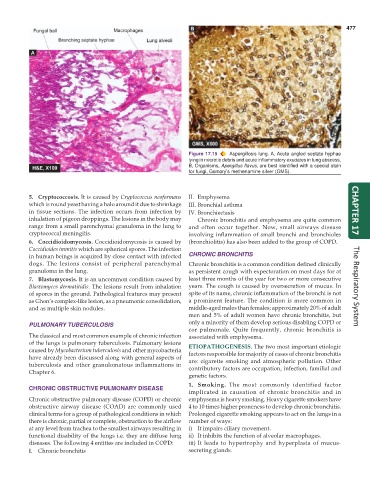
                                                               Figure 17.15  Aspergillosis lung. A, Acute angled septate hyphae
                                                               lying in necrotic debris and acute inflammatory exudates in lung abscess.
                                                               B, Organisms, Apergillus flavus, are best identified with a special stain
                                                               for fungi, Gomory’s methenamine silver (GMS).


           5. Cryptococcosis. It is caused by Cryptococcus neoformans  II. Emphysema
           which is round yeast having a halo around it due to shrinkage  III. Bronchial asthma
           in tissue sections. The infection occurs from infection by  IV. Bronchiectasis                             CHAPTER 17
           inhalation of pigeon droppings. The lesions in the body may  Chronic bronchitis and emphysema are quite common
           range from a small parenchymal granuloma in the lung to  and often occur together. Now, small airways disease
           cryptococcal meningitis.                            involving inflammation of small bronchi and bronchioles
           6. Coccidioidomycosis. Coccidioidomycosis is caused by  (bronchiolitis) has also been added to the group of COPD.
           Coccidioides immitis which are spherical spores. The infection
           in human beings is acquired by close contact with infected  CHRONIC BRONCHITIS
           dogs. The lesions consist of peripheral parenchymal  Chronic bronchitis is a common condition defined clinically
           granuloma in the lung.                              as persistent cough with expectoration on most days for at
           7. Blastomycosis. It is an uncommon condition caused by  least three months of the year for two or more consecutive
           Blastomyces dermatitidis. The lesions result from inhalation  years. The cough is caused by oversecretion of mucus. In  The Respiratory System
           of spores in the ground. Pathological features may present  spite of its name, chronic inflammation of the bronchi is not
           as Ghon’s complex-like lesion, as a pneumonic consolidation,  a prominent feature. The condition is more common in
           and as multiple skin nodules.                       middle-aged males than females; approximately 20% of adult
                                                               men and 5% of adult women have chronic bronchitis, but
           PULMONARY TUBERCULOSIS                              only a minority of them develop serious disabling COPD or
                                                               cor pulmonale. Quite frequently, chronic bronchitis is
           The classical and most common example of chronic infection  associated with emphysema.
           of the lungs is pulmonary tuberculosis. Pulmonary lesions  ETIOPATHOGENESIS. The two most important etiologic
           caused by Mycobacterium tuberculosis and other mycobacteria  factors responsible for majority of cases of chronic bronchitis
           have already been discussed along with general aspects of  are: cigarette smoking and atmospheric pollution. Other
           tuberculosis and other granulomatous inflammations in  contributory factors are occupation, infection, familial and
           Chapter 6.
                                                               genetic factors.
                                                               1. Smoking. The most commonly identified factor
           CHRONIC OBSTRUCTIVE PULMONARY DISEASE
                                                               implicated in causation of chronic bronchitis and in
           Chronic obstructive pulmonary disease (COPD) or chronic  emphysema is heavy smoking. Heavy cigarette smokers have
           obstructive airway disease (COAD) are commonly used  4 to 10 times higher proneness to develop chronic bronchitis.
           clinical terms for a group of pathological conditions in which  Prolonged cigarette smoking appears to act on the lungs in a
           there is chronic, partial or complete, obstruction to the airflow  number of ways:
           at any level from trachea to the smallest airways resulting in  i) It impairs ciliary movement.
           functional disability of the lungs i.e. they are diffuse lung  ii) It inhibits the function of alveolar macrophages.
           diseases. The following 4 entities are included in COPD:  iii) It  leads to hypertrophy and hyperplasia of mucus-
           I. Chronic bronchitis                               secreting glands.

