


Page 499 - Textbook of Pathology, 6th Edition
P. 499
lung is grossly overinflated. Microscopy shows overinflated wheezing. However, a severe and unremitting form of the 483
alveoli and there is histologic evidence of preceding disease termed status asthmaticus may prove fatal.
widespread bronchiolitis obliterans. Bronchial asthma is common and prevalent worldwide;
in the United States about 4% of population is reported to
5. INTERSTITIAL EMPHYSEMA (SURGICAL EMPHY- suffer from this disease. It occurs at all ages but nearly 50%
SEMA). The entry of air into the connective tissue framework
of the lung is called interstitial or surgical emphysema. The of cases develop it before the age of 10 years. In adults, both
sexes are affected equally but in children there is 2:1 male-
usual sources of entry of air into stroma of the lung are female ratio.
rupture of alveoli or of larger airways. The causes are as
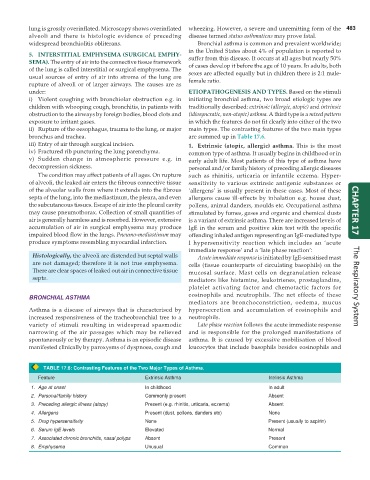
under: ETIOPATHOGENESIS AND TYPES. Based on the stimuli
i) Violent coughing with bronchiolar obstruction e.g. in initiating bronchial asthma, two broad etiologic types are
children with whooping cough, bronchitis, in patients with traditionally described: extrinsic (allergic, atopic) and intrinsic
obstruction to the airways by foreign bodies, blood clots and (idiosyncratic, non-atopic) asthma. A third type is a mixed pattern
exposure to irritant gases. in which the features do not fit clearly into either of the two
ii) Rupture of the oesophagus, trauma to the lung, or major main types. The contrasting features of the two main types
bronchus and trachea. are summed up in Table 17.6.
iii) Entry of air through surgical incision. 1. Extrinsic (atopic, allergic) asthma. This is the most
iv) Fractured rib puncturing the lung parenchyma. common type of asthma. It usually begins in childhood or in
v) Sudden change in atmospheric pressure e.g. in early adult life. Most patients of this type of asthma have
decompression sickness. personal and/or family history of preceding allergic diseases
The condition may affect patients of all ages. On rupture such as rhinitis, urticaria or infantile eczema. Hyper-
of alveoli, the leaked air enters the fibrous connective tissue sensitivity to various extrinsic antigenic substances or
of the alveolar walls from where it extends into the fibrous ‘allergens’ is usually present in these cases. Most of these
septa of the lung, into the mediastinum, the pleura, and even allergens cause ill-effects by inhalation e.g. house dust,
the subcutaneous tissues. Escape of air into the pleural cavity pollens, animal danders, moulds etc. Occupational asthma
may cause pneumothorax. Collection of small quantities of stimulated by fumes, gases and organic and chemical dusts CHAPTER 17
air is generally harmless and is resorbed. However, extensive is a variant of extrinsic asthma. There are increased levels of
accumulation of air in surgical emphysema may produce IgE in the serum and positive skin test with the specific
impaired blood flow in the lungs. Pneumo-mediastinum may offending inhaled antigen representing an IgE-mediated type
produce symptoms resembling myocardial infarction. I hypersensitivity reaction which includes an ‘acute
immediate response’ and a ‘late phase reaction’:
Histologically, the alveoli are distended but septal walls Acute immediate response is initiated by IgE-sensitised mast
are not damaged; therefore it is not true emphysema. cells (tissue counterparts of circulating basophils) on the
There are clear spaces of leaked out air in connective tissue mucosal surface. Mast cells on degranulation release
septa. mediators like histamine, leukotrienes, prostaglandins,
platelet activating factor and chemotactic factors for The Respiratory System
eosinophils and neutrophils. The net effects of these
BRONCHIAL ASTHMA
mediators are bronchoconstriction, oedema, mucus
Asthma is a disease of airways that is characterised by hypersecretion and accumulation of eosinophils and
increased responsiveness of the tracheobronchial tree to a neutrophils.
variety of stimuli resulting in widespread spasmodic Late phase reaction follows the acute immediate response
narrowing of the air passages which may be relieved and is responsible for the prolonged manifestations of
spontaneously or by therapy. Asthma is an episodic disease asthma. It is caused by excessive mobilisation of blood
manifested clinically by paroxysms of dyspnoea, cough and leucocytes that include basophils besides eosinophils and
TABLE 17.6: Contrasting Features of the Two Major Types of Asthma.
Feature Extrinsic Asthma Intrinsic Asthma
1. Age at onset In childhood In adult
2. Personal/family history Commonly present Absent
3. Preceding allergic illness (atopy) Present (e.g. rhinitis, urticaria, eczema) Absent
4. Allergens Present (dust, pollens, danders etc) None
5. Drug hypersensitivity None Present (usually to aspirin)
6. Serum IgE levels Elevated Normal
7. Associated chronic bronchitis, nasal polyps Absent Present
8. Emphysema Unusual Common

