


Page 701 - Textbook of Pathology, 6th Edition
P. 701
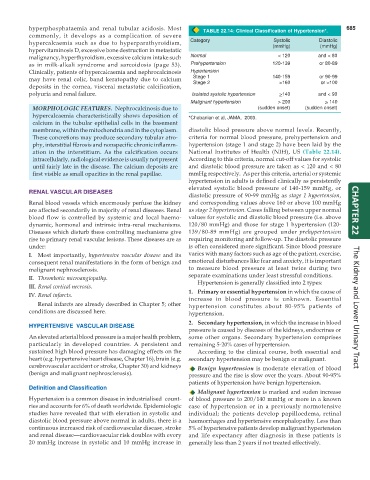
hyperphosphataemia and renal tubular acidosis. Most TABLE 22.14: Clinical Classification of Hypertension*. 685
commonly, it develops as a complication of severe
Systolic
hypercalcaemia such as due to hyperparathyroidism, Category (mmHg) Diastolic
(mmHg)
hypervitaminosis D, excessive bone destruction in metastatic
malignancy, hyperthyroidism, excessive calcium intake such Normal < 120 and < 80
as in milk-alkali syndrome and sarcoidosis (page 53). Prehypertension 120-139 or 80-89
Clinically, patients of hypercalcaemia and nephrocalcinosis Hypertension
may have renal colic, band keratopathy due to calcium Stege 1 140-159 or 90-99
Stege 2
>160
or >100
deposits in the cornea, visceral metastatic calcification,
polyuria and renal failure. Isolated systolic hypertension >140 and < 90
Malignant hypertension > 200 > 140
MORPHOLOGIC FEATURES. Nephrocalcinosis due to (sudden onset) (sudden onset)
hypercalcaemia characteristically shows deposition of *Chobanian et al, JAMA, 2003.
calcium in the tubular epithelial cells in the basement
membrane, within the mitochondria and in the cytoplasm. diastolic blood pressure above normal levels. Recently,
These concretions may produce secondary tubular atro- criteria for normal blood pressure, prehypertension and
phy, interstitial fibrosis and nonspecific chronic inflamm- hypertension (stage 1 and stage 2) have been laid by the
ation in the interstitium. As the calcification occurs National Institutes of Health (NIH), US (Table 22.14).
intracellularly, radiological evidence is usually not present According to this criteria, normal cut-off values for systolic
until fairly late in the disease. The calcium deposits are and diastolic blood pressure are taken as < 120 and < 80
first visible as small opacities in the renal papillae. mmHg respectively. As per this criteria, arterial or systemic
hypertension in adults is defined clinically as persistently
elevated systolic blood pressure of 140-159 mmHg, or
RENAL VASCULAR DISEASES
diastolic pressure of 90-99 mmHg as stage 1 hypertension,
Renal blood vessels which enormously perfuse the kidney and corresponding values above 160 or above 100 mmHg
are affected secondarily in majority of renal diseases. Renal as stage 2 hypertension. Cases falling between upper normal CHAPTER 22
blood flow is controlled by systemic and local haemo- values for systolic and diastolic blood pressure (i.e. above
dynamic, hormonal and intrinsic intra-renal mechanisms. 120/80 mmHg) and those for stage 1 hypertension (120-
Diseases which disturb these controlling mechanisms give 139/80-89 mmHg) are grouped under prehypertension
rise to primary renal vascular lesions. These diseases are as requiring monitoring anf follow-up. The diastolic pressure
under: is often considered more significant. Since blood pressure
I. Most importantly, hypertensive vascular disease and its varies with many factors such as age of the patient, exercise,
consequent renal manifestations in the form of benign and emotional disturbances like fear and anxiety, it is important
malignant nephrosclerosis. to measure blood pressure at least twice during two
II. Thrombotic microangiopathy. separate examinations under least stressful conditions.
Hypertension is generally classified into 2 types:
III. Renal cortical necrosis.
1. Primary or essential hypertension in which the cause of
IV. Renal infarcts.
increase in blood pressure is unknown. Essential
Renal infarcts are already described in Chapter 5; other hypertension constitutes about 80-95% patients of
conditions are discussed here. hypertension. The Kidney and Lower Urinary Tract
2. Secondary hypertension, in which the increase in blood
HYPERTENSIVE VASCULAR DISEASE
pressure is caused by diseases of the kidneys, endocrines or
An elevated arterial blood pressure is a major health problem, some other organs. Secondary hypertension comprises
particularly in developed countries. A persistent and remaining 5-20% cases of hypertension.
sustained high blood pressure has damaging effects on the According to the clinical course, both essential and
heart (e.g. hypertensive heart disease, Chapter 16), brain (e.g. secondary hypertension may be benign or malignant.
cerebrovascular accident or stroke, Chapter 30) and kidneys Benign hypertension is moderate elevation of blood
(benign and malignant nephrosclerosis). pressure and the rise is slow over the years. About 90-95%
patients of hypertension have benign hypertension.
Definition and Classification
Malignant hypertension is marked and suden increase
Hypertension is a common disease in industrialised count- of blood pressure to 200/140 mmHg or more in a known
ries and accounts for 6% of death worldwide. Epidemiologic case of hypertension or in a previously normotensive
studies have revealed that with elevation in systolic and individual; the patients develop papilloedema, retinal
diastolic blood pressure above normal in adults, there is a haemorrhages and hypertensive encephalopathy. Less than
continuous increased risk of cardiovascular disease, stroke 5% of hypertensive patients develop malignant hypertension
and renal disease—cardiovascular risk doubles with every and life expectancy after diagnosis in these patients is
20 mmHg increase in systolic and 10 mmHg increase in generally less than 2 years if not treated effectively.

