


Page 832 - Textbook of Pathology, 6th Edition
P. 832
816                                                      HYPERPARATHYROIDISM
                                                               Hyperfunction of the parathyroid glands occurs due to
                                                               excessive production of parathyroid hormone. It is classified
                                                               into 3 types—primary, secondary and tertiary.
                                                                  Primary hyperparathyroidism occurs from oversecretion of
                                                               parathyroid hormone due to disease of the parathyroid
                                                               glands.
                                                                  Secondary hyperparathyroidism is caused by diseases in
                                                               other parts of the body.
                                                                  Tertiary hyperparathyroidism develops from secondary
                                                               hyperplasia after removal of the cause of secondary
                                                               hyperplasia.

                                                               Primary Hyperparathyroidism
                                                               Primary hyperparathyroidism is not uncommon and occurs
                                                               more commonly with increasing age. It is especially likely
                                                               to occur in women near the time of menopause.

                                                               ETIOLOGY.  Common causes of primary hyperpara-
                                                               thyroidism are as follows:
                                                               1. Most commonly, parathyroid adenomas in approxi-
                                                               mately 80% cases.
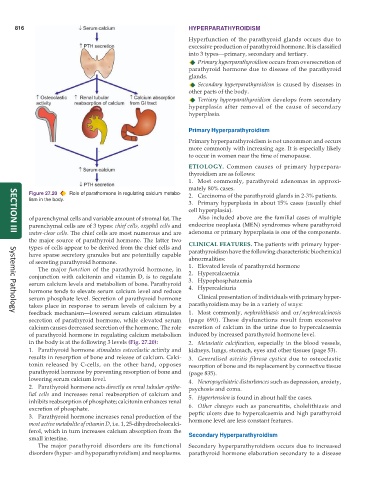
           Figure 27.20  Role of parathormone in regulating calcium metabo-  2. Carcinoma of the parathyroid glands in 2-3% patients.
           lism in the body.
                                                               3. Primary hyperplasia in about 15% cases (usually chief
                                                               cell hyperplasia).
           of parenchymal cells and variable amount of stromal fat. The  Also included above are the familial cases of multiple
           parenchymal cells are of 3 types: chief cells, oxyphil cells and  endocrine neoplasia (MEN) syndromes where parathyroid
           water-clear cells. The chief cells are most numerous and are  adenoma or primary hyperplasia is one of the components.
     SECTION III
           the major source of parathyroid hormone. The latter two  CLINICAL FEATURES. The patients with primary hyper-
           types of cells appear to be derived from the chief cells and  parathyroidism have the following characteristic biochemical
           have sparse secretory granules but are potentially capable  abnormalities:
           of secreting parathyroid hormone.                   1. Elevated levels of parathyroid hormone
              The major  function of the parathyroid hormone, in
           conjunction with calcitonin and vitamin D, is to regulate  2. Hypercalcaemia
                                                               3. Hypophosphataemia
           serum calcium levels and metabolism of bone. Parathyroid  4. Hypercalciuria
           hormone tends to elevate serum calcium level and reduce
           serum phosphate level. Secretion of parathyroid hormone  Clinical presentation of individuals with primary hyper-
           takes place in response to serum levels of calcium by a  parathyroidism may be in a variety of ways:
           feedback mechanism—lowered serum calcium stimulates  1. Most commonly, nephrolithiasis and or/nephrocalcinosis
     Systemic Pathology
           secretion of parathyroid hormone, while elevated serum  (page 690). These dysfunctions result from excessive
           calcium causes decreased secretion of the hormone. The role  excretion of calcium in the urine due to hypercalcaemia
           of parathyroid hormone in regulating calcium metabolism  induced by increased parathyroid hormone level.
           in the body is at the following 3 levels (Fig. 27.20):  2. Metastatic calcification, especially in the blood vessels,
           1. Parathyroid hormone stimulates osteoclastic activity and  kidneys, lungs, stomach, eyes and other tissues (page 53).
           results in resorption of bone and release of calcium. Calci-  3. Generalised osteitis fibrosa cystica due to osteoclastic
           tonin released by C-cells, on the other hand, opposes  resorption of bone and its replacement by connective tissue
           parathyroid hormone by preventing resorption of bone and  (page 835).
           lowering serum calcium level.                       4. Neuropsychiatric disturbances such as depression, anxiety,
           2. Parathyroid hormone acts directly on renal tubular epithe-  psychosis and coma.
           lial cells  and increases renal reabsorption of calcium and  5. Hypertension is found in about half the cases.
           inhibits reabsorption of phosphate; calcitonin enhances renal
           excretion of phosphate.                             6. Other changes such as pancreatitis, cholelithiasis and
           3. Parathyroid hormone increases renal production of the  peptic ulcers due to hypercalcaemia and high parathyroid
           most active metabolite of vitamin D, i.e. 1, 25-dihydrocholecalci-  hormone level are less constant features.
           ferol, which in turn increases calcium absorption from the
           small intestine.                                    Secondary Hyperparathyroidism
              The major parathyroid disorders are its functional  Secondary hyperparathyroidism occurs due to increased
           disorders (hyper- and hypoparathyroidism) and neoplasms.  parathyroid hormone elaboration secondary to a disease

