


Page 829 - Textbook of Pathology, 6th Edition
P. 829
813


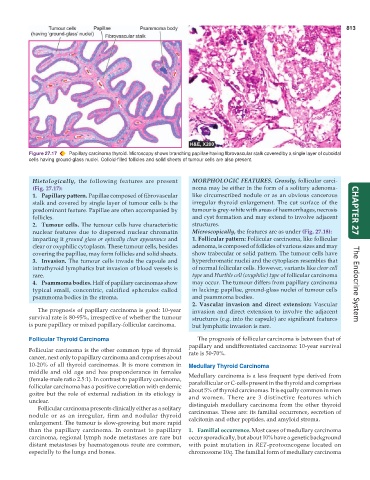
           Figure 27.17  Papillary carcinoma thyroid. Microscopy shows branching papillae having flbrovascular stalk covered by a single layer of cuboidal
           cells having ground-glass nuclei. Colloid-filled follicles and solid sheets of tumour cells are also present.


            Histologically, the following features are present   MORPHOLOGIC FEATURES. Grossly, follicular carci-
            (Fig. 27.17):                                        noma may be either in the form of a solitary adenoma-
            1. Papillary pattern. Papillae composed of fibrovascular  like circumscribed nodule or as an obvious cancerous
            stalk and covered by single layer of tumour cells is the  irregular thyroid enlargement. The cut surface of the
            predominant feature. Papillae are often accompanied by  tumour is grey-white with areas of haemorrhages, necrosis  CHAPTER 27
            follicles.                                           and cyst formation and may extend to involve adjacent
            2. Tumour cells. The tumour cells have characteristic  structures.
            nuclear features due to dispersed nuclear chromatin  Microscopically, the features are as under (Fig. 27.18):
            imparting it ground glass or optically clear appearance and  1. Follicular pattern: Follicular carcinoma, like follicular
            clear or oxyphilic cytoplasm. These tumour cells, besides  adenoma, is composed of follicles of various sizes and may
            covering the papillae, may form follicles and solid sheets.  show trabecular or solid pattern. The tumour cells have
            3. Invasion. The tumour cells invade the capsule and  hyperchromatic nuclei and the cytoplasm resembles that
            intrathyroid lymphatics but invasion of blood vessels is  of normal follicular cells. However, variants like clear cell
            rare.                                                type and Hurthle cell (oxyphilic) type of follicular carcinoma
            4. Psammoma bodies. Half of papillary carcinomas show  may occur. The tumour differs from papillary carcinoma  The Endocrine System
            typical small, concentric, calcified spherules called  in lacking: papillae, ground-glass nuclei of tumour cells
            psammoma bodies in the stroma.                       and psammoma bodies.
                                                                 2. Vascular invasion and direct extension: Vascular
              The prognosis of papillary carcinoma is good: 10-year  invasion and direct extension to involve the adjacent
           survival rate is 80-95%, irrespective of whether the tumour  structures (e.g. into the capsule) are significant features
           is pure papillary or mixed papillary-follicular carcinoma.  but lymphatic invasion is rare.

           Follicular Thyroid Carcinoma                           The prognosis of follicular carcinoma is between that of
                                                               papillary and undifferentiated carcinoma: 10-year survival
           Follicular carcinoma is the other common type of thyroid  rate is 50-70%.
           cancer, next only to papillary carcinoma and comprises about
           10-20% of all thyroid carcinomas. It is more common in  Medullary Thyroid Carcinoma
           middle and old age and has preponderance in females  Medullary carcinoma is a less frequent type derived from
           (female-male ratio 2.5:1). In contrast to papillary carcinoma,  parafollicular or C-cells present in the thyroid and comprises
           follicular carcinoma has a positive correlation with endemic  about 5% of thyroid carcinomas. It is equally common in men
           goitre but the role of external radiation in its etiology is  and women. There are 3 distinctive features which
           unclear.                                            distinguish medullary carcinoma from the other thyroid
              Follicular carcinoma presents clinically either as a solitary
           nodule or as an irregular, firm and nodular thyroid  carcinomas. These are: its familial occurrence, secretion of
                                                               calcitonin and other peptides, and amyloid stroma.
           enlargement. The tumour is slow-growing but more rapid
           than the papillary carcinoma. In contrast to papillary  1. Familial occurrence. Most cases of medullary carcinoma
           carcinoma, regional lymph node metastases are rare but  occur sporadically, but about 10% have a genetic background
           distant metastases by haematogenous route are common,  with point mutation in  RET-protooncogene located on
           especially to the lungs and bones.                  chromosome 10q. The familial form of medullary carcinoma

