


Page 830 - Textbook of Pathology, 6th Edition
P. 830
814


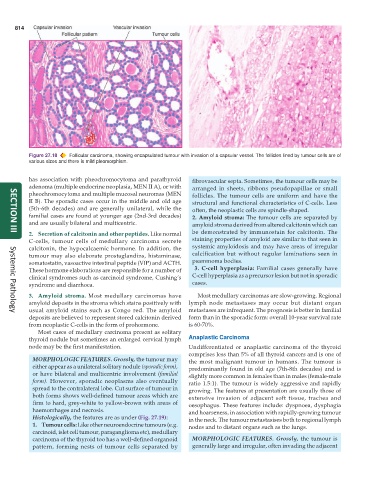
           Figure 27.18  Follicular carcinoma, showing encapsulated tumour with invasion of a capsular vessel. The follicles lined by tumour cells are of
           various sizes and there is mild pleomorphism.

           has association with pheochromocytoma and parathyroid  fibrovascular septa. Sometimes, the tumour cells may be
           adenoma (multiple endocrine neoplasia, MEN II A), or with  arranged in sheets, ribbons pseudopapillae or small
           pheochromocytoma and multiple mucosal neuromas (MEN   follicles. The tumour cells are uniform and have the
           II B). The sporadic cases occur in the middle and old age  structural and functional characteristics of C-cells. Less
           (5th-6th decades) and are generally unilateral, while the  often, the neoplastic cells are spindle-shaped.
           familial cases are found at younger age (2nd-3rd decades)  2. Amyloid stroma: The tumour cells are separated by
           and are usually bilateral and multicentric.           amyloid stroma derived from altered calcitonin which can

           2. Secretion of calcitonin and other peptides. Like normal  be demonstrated by immunostain for calcitonin. The
     SECTION III
           C-cells, tumour cells of medullary carcinoma secrete  staining properties of amyloid are similar to that seen in
           calcitonin, the hypocalcaemic hormone. In addition, the  systemic amyloidosis and may have areas of irregular
           tumour may also elaborate prostaglandins, histaminase,  calcification but without regular laminations seen in
           somatostatin, vasoactive intestinal peptide (VIP) and ACTH.  psammoma bodies.
           These hormone elaborations are responsible for a number of    3. C-cell hyperplasia: Familial cases generally have
           clinical syndromes such as carcinoid syndrome, Cushing’s  C-cell hyperplasia as a precursor lesion but not in sporadic
           syndrome and diarrhoea.                               cases.
           3. Amyloid stroma.  Most medullary carcinomas have     Most medullary carcinomas are slow-growing. Regional
           amyloid deposits in the stroma which stains positively with  lymph node metastases may occur but distant organ
           usual amyloid stains such as Congo red. The amyloid  metastases are infrequent. The prognosis is better in familial
     Systemic Pathology
           deposits are believed to represent stored calcitonin derived  form than in the sporadic form: overall 10-year survival rate
           from neoplastic C-cells in the form of prohormone.  is 60-70%.
              Most cases of medullary carcinoma present as solitary
           thyroid nodule but sometimes an enlarged cervical lymph  Anaplastic Carcinoma
           node may be the first manifestation.                Undifferentiated or anaplastic carcinoma of the thyroid
                                                               comprises less than 5% of all thyroid cancers and is one of
            MORPHOLOGIC FEATURES. Grossly, the tumour may      the most malignant tumour in humans. The tumour is
            either appear as a unilateral solitary nodule (sporadic form),  predominantly found in old age (7th-8th decades) and is
            or have bilateral and multicentric involvement (familial  slightly more common in females than in males (female-male
            form). However, sporadic neoplasms also eventually  ratio 1.5:1). The tumour is widely aggressive and rapidly
            spread to the contralateral lobe. Cut surface of tumour in  growing. The features at presentation are usually those of
            both forms shows well-defined tumour areas which are  extensive invasion of adjacent soft tissue, trachea and
            firm to hard, grey-white to yellow-brown with areas of  oesophagus. These features include: dyspnoea, dysphagia
            haemorrhages and necrosis.                         and hoarseness, in association with rapidly-growing tumour
            Histologically, the features are as under (Fig. 27.19):  in the neck. The tumour metastasises both to regional lymph
            1. Tumour cells: Like other neuroendocrine tumours (e.g.  nodes and to distant organs such as the lungs.
            carcinoid, islet cell tumour, paraganglioma etc), medullary
            carcinoma of the thyroid too has a well-defined organoid  MORPHOLOGIC FEATURES. Grossly, the tumour is
            pattern, forming nests of tumour cells separated by  generally large and irregular, often invading the adjacent

