


Page 833 - Textbook of Pathology, 6th Edition
P. 833
Primary Hypoparathyroidism                           817
                                                               Primary hypoparathyroidism is caused by disease of the
                                                               parathyroid glands. Most common causes of primary
                                                               hypoparathyroidism are: surgical procedures involving
                                                               thyroid, parathyroid, or radical neck dissection for cancer.
                                                               Other causes are uncommon and include idiopathic
                                                               hypoparathyroidism of autoimmune origin in children and
                                                               may occur as sporadic or familial cases. These cases are
                                                               generally associated with other autoimmune diseases.
                                                               CLINICAL FEATURES. The main biochemical dysfunctions
                                                               in primary hypoparathyroidism are hypocalcaemia,
                                                               hyperphosphataemia and hypocalciuria. The clinical
                                                               manifestations of these abnormalities are as under:
                                                               1. Increased neuromuscular irritability and tetany
                                                               2. Calcification of the lens and cataract formation
                                                               3. Abnormalities in cardiac conduction
                                                               4. Disorders of the CNS due to intracranial calcification
                                                               5. Abnormalities of the teeth.
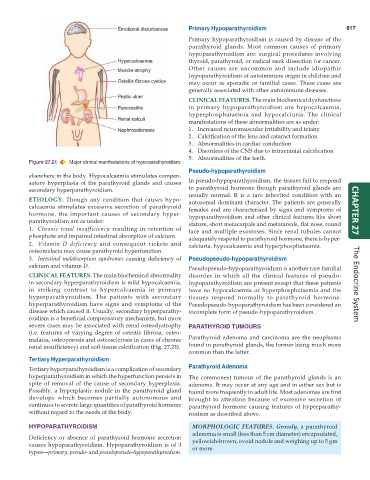
           Figure 27.21  Major clinical manifestations of hyperparathyroidism.
                                                               Pseudo-hypoparathyroidism
           elsewhere in the body. Hypocalcaemia stimulates compen-
           satory hyperplasia of the parathyroid glands and causes  In pseudo-hypoparathyroidism, the tissues fail to respond
           secondary hyperparathyroidism.                      to parathyroid hormone though parathyroid glands are
                                                               usually normal. It is a rare inherited condition with an
           ETIOLOGY.  Though any condition that causes hypo-   autosomal dominant character. The patients are generally
           calcaemia stimulates excessive secretion of parathyroid  females and are characterised by signs and symptoms of
           hormone, the important causes of secondary hyper-   hypoparathyroidism and other clinical features like short  CHAPTER 27
           parathyroidism are as under:                        stature, short metacarpals and metatarsals, flat nose, round
           1. Chronic renal insufficiency resulting in retention of  face and multiple exostoses. Since renal tubules cannot
           phosphate and impaired intestinal absorption of calcium.  adequately respond to parathyroid hormone, there is hyper-
           2. Vitamin D deficiency and consequent rickets and  calciuria, hypocalcaemia and hyperphosphataemia.
           osteomalacia may cause parathyroid hyperfunction.
           3. Intestinal malabsorption syndromes causing deficiency of  Pseudopseudo-hypoparathyroidism
           calcium and vitamin D.                              Pseudopseudo-hypoparathyroidism is another rare familial
           CLINICAL FEATURES. The main biochemical abnormality  disorder in which all the clinical features of pseudo-
           in secondary hyperparathyroidism is mild hypocalcaemia,  hypoparathyroidism are present except that these patients  The Endocrine System
           in striking contrast to hypercalcaemia in primary   have no hypocalcaemia or hyperphosphataemia and the
           hyperparathyroidism. The patients with secondary    tissues respond normally to parathyroid hormone.
           hyperparathyroidism have signs and symptoms of the  Pseudopseudo-hypoparathyroidism has been considered an
           disease which caused it. Usually, secondary hyperparathy-  incomplete form of pseudo-hypoparathyroidism.
           roidism is a beneficial compensatory mechanism, but more
           severe cases may be associated with renal osteodystrophy  PARATHYROID TUMOURS
           (i.e. features of varying degree of osteitis fibrosa, osteo-
           malacia, osteoporosis and osteosclerosis in cases of chronic  Parathyroid adenoma and carcinoma are the neoplasms
           renal insufficiency) and soft tissue calcification (Fig. 27.21).  found in parathyroid glands, the former being much more
                                                               common than the latter.
           Tertiary Hyperparathyroidism
           Tertiary hyperparathyroidism is a complication of secondary  Parathyroid Adenoma
           hyperparathyroidism in which the hyperfunction persists in  The commonest tumour of the parathyroid glands is an
           spite of removal of the cause of secondary hyperplasia.  adenoma. It may occur at any age and in either sex but is
           Possibly, a hyperplastic nodule in the parathyroid gland  found more frequently in adult life. Most adenomas are first
           develops which becomes partially autonomous and     brought to attention because of excessive secretion of
           continues to secrete large quantities of parathyroid hormone  parathyroid hormone causing features of hyperparathy-
           without regard to the needs of the body.            roidism as described above.

           HYPOPARATHYROIDISM                                    MORPHOLOGIC FEATURES. Grossly, a parathyroid
                                                                 adenoma is small (less than 5 cm diameter) encapsulated,
           Deficiency or absence of parathyroid hormone secretion  yellowish-brown, ovoid nodule and weighing up to 5 gm
           causes hypoparathyroidism. Hypoparathyroidism is of 3  or more.
           types—primary, pseudo- and pseudopseudo-hypoparathyroidism.

