


Page 834 - Textbook of Pathology, 6th Edition
P. 834
818 Microscopically, majority of adenomas are predominantly causes secretory diarrhoea by stimulation of gastrointestinal
composed of chief cells arranged in sheets or cords. fluid secretion.
Oxyphil cells and water-clear cells may be found 2. Enterochromaffin cells synthesise serotonin which in
intermingled in varying proportions. Usually, a rim of pancreatic tumours may induce carcinoid syndrome.
normal parathyroid parenchyma and fat are present
external to the capsule which help to distinguish an DIABETES MELLITUS
adenoma from diffuse hyperplasia. Definition and Epidemiology
Parathyroid Carcinoma As per the WHO, diabetes mellitus (DM) is defined as a hetro-
geneous metabolic disorder characterised by common feature
Carcinoma of the parathyroid is rare and produces manifes- of chronic hyperglycaemia with disturbance of carbohydrate,
tations of hyperparathyroidism which is often more fat and protein metabolism.
pronounced. Carcinoma tends to be irregular in shape and DM is a leading cause of morbidity and mortality world
is adherent to the adjacent tissues. Most parathyroid over. It is estimated that approximately 1% of population
carcinomas are well-differentiated. It may be difficult to suffers from DM. The incidence is rising in the developed
distinguish carcinoma of parathyroid gland from an adenoma countries of the world at the rate of about 10% per year,
but local invasion of adjacent tissues and distant metastases especially of type 2 DM, due to rising incidence of obesity
are helpful criteria of malignancy in such cases. and reduced activity levels. DM is expected to continue as a
major health problem owing to its serious complications,
ENDOCRINE PANCREAS especially end-stage renal disease, IHD, gangrene of the
lower extremities, and blindness in the adults. It is anticipated
The human pancreas, though anatomically a single organ, that the number of diabetics will exceed 250 million by the
histologically and functionally, has 2 distinct parts—the year 2010.
exocrine and endocrine. The exocrine part of the gland and
its disorders have already been discussed in Chapter 21. Classification and Etiology
The discussion here is focused on the endocrine pancreas The older classification systems dividing DM into primary
and its two main disorders: diabetes mellitus and islet cell (idiopathic) and secondary types, juvenile-onset and maturity
tumours. onset types, and insulin-dependent (IDDM) and non-insulin
dependent (NIDDM) types, have become obsolete and
NORMAL STRUCTURE
undergone major revision due to extensive understanding
SECTION III
The endocrine pancreas consists of microscopic collections of etiology and pathogenesis of DM in recent times.
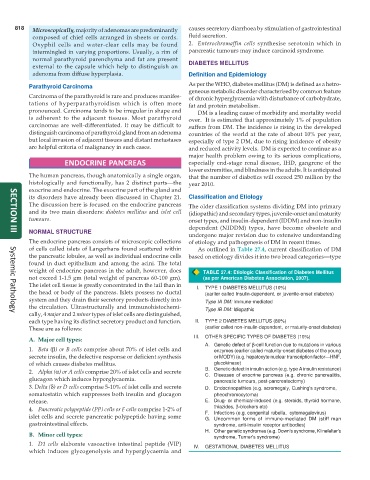
of cells called islets of Langerhans found scattered within As outlined in Table 27.4, current classification of DM
the pancreatic lobules, as well as individual endocrine cells based on etiology divides it into two broad categories—type
found in duct epithelium and among the acini. The total
weight of endocrine pancreas in the adult, however, does TABLE 27.4: Etiologic Classification of Diabetes Mellitus
not exceed 1-1.5 gm (total weight of pancreas 60-100 gm). (as per American Diabetes Association, 2007).
The islet cell tissue is greatly concentrated in the tail than in I. TYPE 1 DIABETES MELLITUS (10%)
the head or body of the pancreas. Islets possess no ductal (earlier called Insulin-dependent, or juvenile-onset diabetes)
system and they drain their secretory products directly into Type IA DM: Immune-mediated
the circulation. Ultrastructurally and immunohistochemi- Type IB DM: Idiopathic
cally, 4 major and 2 minor types of islet cells are distinguished,
Systemic Pathology
each type having its distinct secretory product and function. II. TYPE 2 DIABETES MELLITUS (80%)
These are as follows: (earlier called non-insulin-dependent, or maturity-onset diabetes)
A. Major cell types: III. OTHER SPECIFIC TYPES OF DIABETES (10%)
A. Genetic defect of β-cell function due to mutations in various
1. Beta (β) or B cells comprise about 70% of islet cells and enzymes (earlier called maturity-onset diabetes of the young
secrete insulin, the defective response or deficient synthesis or MODY) (e.g. hepatocyte nuclear transcription factor—HNF,
of which causes diabetes mellitus. glucokinase)
2. Alpha (α) or A cells comprise 20% of islet cells and secrete B. Genetic defect in insulin action (e.g. type A insulin resistance)
C. Diseases of exocrine pancreas (e.g. chronic pancreatitis,
glucagon which induces hyperglycaemia. pancreatic tumours, post-pancreatectomy)
3. Delta (δ) or D cells comprise 5-10% of islet cells and secrete D. Endocrinopathies (e.g. acromegaly, Cushing's syndrome,
somatostatin which suppresses both insulin and glucagon pheochromocytoma)
release. E. Drug- or chemical-induced (e.g. steroids, thyroid hormone,
4. Pancreatic polypeptide (PP) cells or F cells comprise 1-2% of thiazides, β-blockers etc)
islet cells and secrete pancreatic polypeptide having some F. Infections (e.g. congenital rubella, cytomegalovirus)
G. Uncommon forms of immune-mediated DM (stiff man
gastrointestinal effects. syndrome, anti-insulin receptor antibodies)
H. Other genetic syndromes (e.g. Down's syndrome, Klinefelter's
B. Minor cell types: syndrome, Turner's syndrome)
1. D1 cells elaborate vasoactive intestinal peptide (VIP) IV. GESTATIONAL DIABETES MELLITUS
which induces glycogenolysis and hyperglycaemia and

