


Page 865 - Textbook of Pathology, 6th Edition
P. 865
849


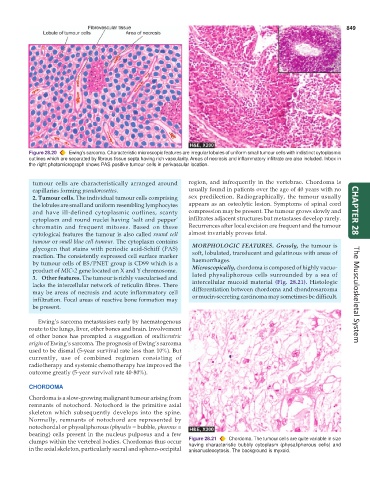
           Figure 28.20  Ewing’s sarcoma. Characteristic microscopic features are irregular lobules of uniform small tumour cells with indistinct cytoplasmic
           outlines which are separated by fibrous tissue septa having rich vascularity. Areas of necrosis and inflammatory infiltrate are also included. Inbox in
           the right photomicrograph shows PAS positive tumour cells in perivascular location.


            tumour cells are characteristically arranged around  region, and infrequently in the vertebrae. Chordoma is
            capillaries forming pseudorosettes.                usually found in patients over the age of 40 years with no
            2. Tumour cells. The individual tumour cells comprising  sex predilection. Radiographically, the tumour usually
            the lobules are small and uniform resembling lymphocytes  appears as an osteolytic lesion. Symptoms of spinal cord
            and have ill-defined cytoplasmic outlines, scanty  compression may be present. The tumour grows slowly and  CHAPTER 28
            cytoplasm and round nuclei having ‘salt and pepper’  infiltrates adjacent structures but metastases develop rarely.
            chromatin and frequent mitoses. Based on these     Recurrences after local excision are frequent and the tumour
            cytological features the tumour is also called round cell  almost invariably proves fatal.
            tumour or small blue cell tumour. The cytoplasm contains  MORPHOLOGIC FEATURES. Grossly, the tumour is
            glycogen that stains with periodic acid-Schiff (PAS)  soft, lobulated, translucent and gelatinous with areas of
            reaction. The consistently expressed cell surface marker  haemorrhages.
            by tumour cells of ES/PNET group is CD99 which is a  Microscopically, chordoma is composed of highly vacuo-
            product of MIC-2 gene located on X and Y chromosome.  lated physaliphorous cells surrounded by a sea of
            3. Other features. The tumour is richly vascularised and  intercellular mucoid material  (Fig. 28.21). Histologic
            lacks the intercellular network of reticulin fibres. There  differentiation between chordoma and chondrosarcoma
            may be areas of necrosis and acute inflammatory cell  or mucin-secreting carcinoma may sometimes be difficult.  The Musculoskeletal System
            infiltration. Focal areas of reactive bone formation may
            be present.

              Ewing’s sarcoma metastasises early by haematogenous
           route to the lungs, liver, other bones and brain. Involvement
           of other bones has prompted a suggestion of multicentric
           origin of Ewing’s sarcoma. The prognosis of Ewing’s sarcoma
           used to be dismal (5-year survival rate less than 10%). But
           currently, use of combined regimen consisting of
           radiotherapy and systemic chemotherapy has improved the
           outcome greatly (5-year survival rate 40-80%).

           CHORDOMA
           Chordoma is a slow-growing malignant tumour arising from
           remnants of notochord. Notochord is the primitive axial
           skeleton which subsequently develops into the spine.
           Normally, remnants of notochord are represented by
           notochordal or physaliphorous (physalis = bubble, phorous =
           bearing) cells present in the nucleus pulposus and a few
           clumps within the vertebral bodies. Chordomas thus occur  Figure 28.21  Chordoma. The tumour cells are quite variable in size
                                                               having characteristic bubbly cytoplasm (physaliphorous cells) and
           in the axial skeleton, particularly sacral and spheno-occipital  anisonucleocytosis. The background is myxoid.

