


Page 866 - Textbook of Pathology, 6th Edition
P. 866
850                                                      composed of inner layer of 1-4 cell thick synoviocytes and
                                                               outer layer of loose vascular connective tissue. On electron
                                                               microscopy, two types of synoviocytes are distinguished:
                                                               type A and type B. Type A synoviocytes are more numerous
                                                               and are related to macrophages and produce degradative
                                                               enzymes, while type B synthesise hyaluronic acid.
                                                                  Diseases of joints are numerous and joints are also invol-
                                                               ved in several systemic disorders. In the following discussion,
                                                               only those joint diseases which are morphologically
                                                               significant are described. Synovial tumours are discussed in
                                                               the next chapter together with other soft tissue tumours.

                                                               OSTEOARTHRITIS
                                                               Osteoarthritis (OA), also called osteoarthrosis or degenerative
                                                               joint disease (DJD), is the most common form of chronic
                                                               disorder of synovial joints. It is characterised by progressive
                                                               degenerative changes in the articular cartilages over the
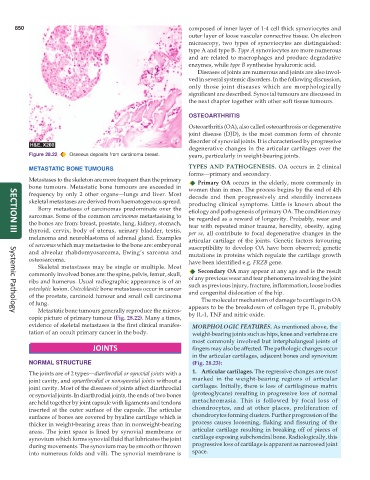
           Figure 28.22  Osseous deposits from carcinoma breast.  years, particularly in weight-bearing joints.

           METASTATIC BONE TUMOURS                             TYPES AND PATHOGENESIS. OA occurs in 2 clinical
                                                               forms—primary and secondary.
           Metastases to the skeleton are more frequent than the primary  Primary OA occurs in the elderly, more commonly in
           bone tumours. Metastatic bone tumours are exceeded in  women than in men. The process begins by the end of 4th
           frequency by only 2 other organs—lungs and liver. Most  decade and then progressively and steadily increases
           skeletal metastases are derived from haematogenous spread.  producing clinical symptoms. Little is known about the
              Bony metastases of carcinomas predominate over the  etiology and pathogenesis of primary OA. The condition may
           sarcomas. Some of the common carcinomas metastasising to  be regarded as a reward of longevity. Probably, wear and
           the bones are from: breast, prostate, lung, kidney, stomach,  tear with repeated minor trauma, heredity, obesity, aging
           thyroid, cervix, body of uterus, urinary bladder, testis,  per se, all contribute to focal degenerative changes in the
     SECTION III
           melanoma and neuroblastoma of adrenal gland. Examples  articular cartilage of the joints. Genetic factors favouring
           of sarcomas which may metastasise to the bone are: embryonal  susceptibility to develop OA have been observed; genetic
           and alveolar rhabdomyosarcoma, Ewing’s sarcoma and  mutations in proteins which regulate the cartilage growth
           osteosarcoma.                                       have been identified e.g. FRZB gene.
              Skeletal metastases may be single or multiple. Most
                                                                  Secondary OA may appear at any age and is the result
           commonly involved bones are: the spine, pelvis, femur, skull,  of any previous wear and tear phenomena involving the joint
           ribs and humerus. Usual radiographic appearance is of an
           osteolytic lesion. Osteoblastic bone metastases occur in cancer  such as previous injury, fracture, inflammation, loose bodies
           of the prostate, carcinoid tumour and small cell carcinoma  and congenital dislocation of the hip.
           of lung.                                                 The molecular mechanism of damage to cartilage in OA
              Metastatic bone tumours generally reproduce the micros-  appears to be the breakdown of collagen type II, probably
     Systemic Pathology
           copic picture of primary tumour (Fig. 28.22). Many a times,  by IL-1, TNF and nitric oxide.
           evidence of skeletal metastases is the first clinical manifes-  MORPHOLOGIC FEATURES. As mentioned above, the
           tation of an occult primary cancer in the body.       weight-bearing joints such as hips, knee and vertebrae are
                                                                 most commonly involved but interphalangeal joints of
                                JOINTS                           fingers may also be affected. The pathologic changes occur
                                                                 in the articular cartilages, adjacent bones and synovium
           NORMAL STRUCTURE                                      (Fig. 28.23):
           The joints are of 2 types—diarthrodial or synovial joints with a  1. Articular cartilages. The regressive changes are most
           joint cavity, and synarthrodial or nonsynovial joints without a  marked in the weight-bearing regions of articular
           joint cavity. Most of the diseases of joints affect diarthrodial  cartilages. Initially, there is loss of cartilaginous matrix
           or synovial joints. In diarthrodial joints, the ends of two bones  (proteoglycans) resulting in progressive loss of normal
           are held together by joint capsule with ligaments and tendons  metachromasia. This is followed by focal loss of
           inserted at the outer surface of the capsule. The articular  chondrocytes, and at other places, proliferation of
           surfaces of bones are covered by hyaline cartilage which is  chondrocytes forming clusters. Further progression of the
           thicker in weight-bearing areas than in nonweight-bearing  process causes loosening, flaking and fissuring of the
           areas. The joint space is lined by synovial membrane or  articular cartilage resulting in breaking off of pieces of
           synovium which forms synovial fluid that lubricates the joint  cartilage exposing subchondral bone. Radiologically, this
           during movements. The synovium may be smooth or thrown  progressive loss of cartilage is apparent as narrowed joint
           into numerous folds and villi. The synovial membrane is  space.

