


Page 867 - Textbook of Pathology, 6th Edition
P. 867
RA is a common disease having peak incidence in 3rd to  851
                                                               4th decades of life, with 3-5 times higher preponderance in
                                                               females. The condition has high association with HLA-DR4
                                                               and HLA-DR1 and familial aggregation. The onset of disease
                                                               is insidious, beginning with prodrome of fatigue, weakness,
                                                               joint stiffness, vague arthralgias and myalgias. This is
                                                               followed by pain and swelling of joints usually in
                                                               symmetrical fashion, especially involving joints of hands,
                                                               wrists and feet. Unlike migratory polyarthritis of rheumatic
                                                               fever, RA usually persists in the involved joint.
                                                               Approximately 20% of patients develop rheumatoid nodules
                                                               located over the extensor surfaces of the elbows and fingers.
                                                                  About 80% of cases are seropositive for rheumatoid factor
                                                               (RF). However, RF titres are elevated in certain unrelated
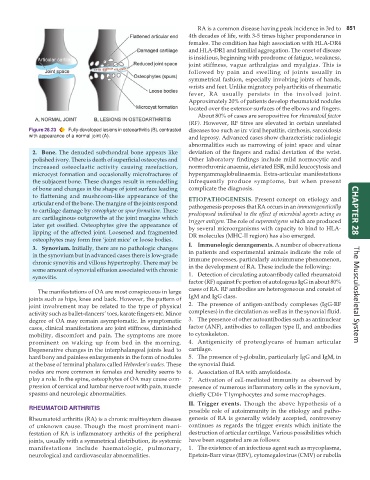
           Figure 28.23  Fully-developed lesions in osteoarthritis (B), contrasted  diseases too such as in: viral hepatitis, cirrhosis, sarcoidosis
           with appearance of a normal joint (A).              and leprosy. Advanced cases show characteristic radiologic
                                                               abnormalities such as narrowing of joint space and ulnar
            2. Bone. The denuded subchondral bone appears like  deviation of the fingers and radial deviation of the wrist.
            polished ivory. There is death of superficial osteocytes and  Other laboratory findings include mild normocytic and
            increased osteoclastic activity causing rarefaction,  normochromic anaemia, elevated ESR, mild leucocytosis and
            microcyst formation and occasionally microfractures of  hypergammaglobulinaemia. Extra-articular manifestations
            the subjacent bone. These changes result in remodelling  infrequently produce symptoms, but when present
            of bone and changes in the shape of joint surface leading  complicate the diagnosis.
            to flattening and mushroom-like appearance of the  ETIOPATHOGENESIS. Present concept on etiology and
            articular end of the bone. The margins of the joints respond
            to cartilage damage by osteophyte or spur formation. These  pathogenesis proposes that RA occurs in an immunogenetically  CHAPTER 28
            are cartilaginous outgrowths at the joint margins which  predisposed individual to the effect of microbial agents acting as
                                                               trigger antigen. The role of superantigens which are produced
            later get ossified. Osteophytes give the appearance of  by several microorganisms with capacity to bind to HLA-
            lipping of the affected joint. Loosened and fragmented  DR molecules (MHC-II region) has also emerged.
            osteophytes may form free ‘joint mice’ or loose bodies.
            3. Synovium. Initially, there are no pathologic changes  I. Immunologic derangements. A number of observations
            in the synovium but in advanced cases there is low-grade  in patients and experimental animals indicate the role of
            chronic synovitis and villous hypertrophy. There may be  immune processes, particularly autoimmune phenomenon,
            some amount of synovial effusion associated with chronic  in the development of RA. These include the following:
            synovitis.                                         1. Detection of circulating autoantibody called rheumatoid
                                                               factor (RF) against Fc portion of autologous IgG in about 80%
              The manifestations of OA are most conspicuous in large  cases of RA. RF antibodies are heterogeneous and consist of
           joints such as hips, knee and back. However, the pattern of  IgM and IgG class.                            The Musculoskeletal System
           joint involvement may be related to the type of physical  2. The presence of antigen-antibody complexes (IgG-RF
           activity such as ballet-dancers’ toes, karate fingers etc. Minor  complexes) in the circulation as well as in the synovial fluid.
           degree of OA may remain asymptomatic. In symptomatic  3. The presence of other autoantibodies such as antinuclear
           cases, clinical manifestations are joint stiffness, diminished  factor (ANF), antibodies to collagen type II, and antibodies
           mobility, discomfort and pain. The symptoms are more  to cytoskeleton.
           prominent on waking up from bed in the morning.     4. Antigenicity of proteoglycans of human articular
           Degenerative changes in the interphalangeal joints lead to  cartilage.
           hard bony and painless enlargements in the form of nodules  5. The presence of γ-globulin, particularly IgG and IgM, in
           at the base of terminal phalanx called Heberden’s nodes. These  the synovial fluid.
           nodes are more common in females and heredity seems to  6. Association of RA with amyloidosis.
           play a role. In the spine, osteophytes of OA may cause com-  7. Activation of cell-mediated immunity as observed by
           pression of cervical and lumbar nerve root with pain, muscle  presence of numerous inflammatory cells in the synovium,
           spasms and neurologic abnormalities.                chiefly CD4+ T lymphocytes and some macrophages.
                                                               II. Trigger events. Though the above hypothesis of a
           RHEUMATOID ARTHRITIS
                                                               possible role of autoimmunity in the etiology and patho-
           Rheumatoid arthritis (RA) is a chronic multisystem disease  genesis of RA is generally widely accepted, controversy
           of unknown cause. Though the most prominent mani-   continues as regards the trigger events which initiate the
           festation of RA is inflammatory arthritis of the peripheral  destruction of articular cartilage. Various possibilities which
           joints, usually with a symmetrical distribution, its systemic  have been suggested are as follows:
           manifestations include haematologic, pulmonary,     1. The existence of an infectious agent such as mycoplasma,
           neurological and cardiovascular abnormalities.      Epstein-Barr virus (EBV), cytomegalovirus (CMV) or rubella

