


Page 169 - The Book of Caterpillars: A Life-Size Guide to Six Hundred Species From Around the World
P. 169
BUTTERFLY CATERPILLARS
FAMILY Lycaenidae
DISTRIBUTION Eastern and southeastern Australia
HABITAT Eucalypt woodlands supporting high densities of host plant
HOST PLANTS Several species of mistletoe, mainly Amyema spp.
NOTE Nocturnal-feeding caterpillar always attended by large,
aggressive sugar ants
CONSERVATION STATUS Not evaluated, but locally common in the north of its range
and uncommon in the south
ADULT WINGSPAN
1⅞–2⁄ in (47–53 mm)
CATERPILLAR LENGTH
1¼ in (32 mm)
OGYRIS GENOVEVA
SOUTHERN PURPLE AZURE 167
(HEWITSON, [1853])
The caterpillars of the Southern Purple Azure hatch from eggs
laid singly on the mistletoe host plant or under loose bark. The
small caterpillars congregate under bark and are attended by
large sugar ants, emerging at night to feed on the mistletoe
leaves. Larger caterpillars rest in temporary ant nests in hollow
limbs of the host tree or under rocks, or in galleries underground
at the tree base. Up to 200 caterpillars can occur in these nests,
and they follow silk trails each night to feed on mistletoe that
may be more than 33 ft (10 m) away.
The caterpillars pupate in the ant nests and remain guarded
by the ants. The pupa is attached by anal hooks into a silken pad
and supported by a central girdle. The adults are local and fast
flying, and males are strong hilltoppers. The genus Ogyris has
15 species, 14 from Australia and one from Papua New Guinea.
All are associated with ants, but in three species the caterpillars Actual size
are thought to prey on ant broods.
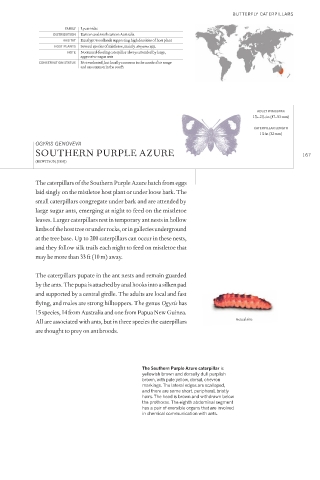
The Southern Purple Azure caterpillar is
yellowish brown and dorsally dull purplish
brown, with pale yellow, dorsal, chevron
markings. The lateral edges are scalloped,
and there are some short, peripheral, bristly
hairs. The head is brown and withdrawn below
the prothorax. The eighth abdominal segment
has a pair of eversible organs that are involved
in chemical communication with ants.

