


Page 170 - The Book of Caterpillars: A Life-Size Guide to Six Hundred Species From Around the World
P. 170
BUTTERFLY CATERPILLARS

                                                     FAMILY  Lycaenidae
                                                 DISTRIBUTION  United States, from Connecticut west to southeast Iowa and
                                                          Missouri, south to east Texas, the Gulf Coast, and peninsular
                                                          Florida, with rare strays to Michigan and Wisconsin
                                                    HABITAT  Forest and forest edges
                                                  HOST PLANTS  Oak (Quercus spp.)
                                                      NOTE  Cryptically green caterpillar found on the underside of leaves
                                             CONSERVATION STATUS  Not evaluated, but common


            ADULT WINGSPAN
           1¼–1⅝ in (32–41 mm)
           CATERPILLAR LENGTH
            ¾–1 in (20–25 mm)
                                                                          PARRHASIUS M-ALBUM
                                                       WHITE M HAIRSTREAK
    168
                                                                            (BOISDUVAL & LECONTE, 1833)


                                            White M Hairstreak caterpillars hatch from eggs likely laid at
                                            the tip of branches of large trees, as do other hairstreak species
                                            that feed on oak. Although the species’ complete life history has
                                            not yet been described, it is probable that the young larvae, like
                                            those of many other hairstreaks, feed on buds and fresh growth
                      Actual size
                                            before moving to larger leaves. There are three generations a
                                            year. Two will pupate on the underside of host plant leaves,
                                            while the overwintering generation likely pupates in leaf litter.
                                            Before pupation, the caterpillar turns reddish brown, makes
                                            a silk pad on the leaf, and attaches itself with a girdle.


                                            Like other lycaenid larvae, this caterpillar can be distinguished
                                            from those of other families by the fleshy lobe on each proleg,

                                            flanked on each side by rows of crochets—hardened hooklike

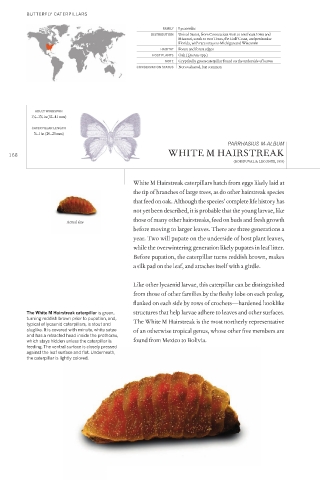
          The White M Hairstreak caterpillar is green,   structures that help larvae adhere to leaves and other surfaces.
          turning reddish brown prior to pupation, and,   The White M Hairstreak is the most northerly representative
          typical of lycaenid caterpillars, is stout and

          sluglike. It is covered with minute, white setae   of an otherwise tropical genus, whose other five members are
          and has a retracted head inside the prothorax,
          which stays hidden unless the caterpillar is   found from Mexico to Bolivia.
          feeding. The ventral surface is closely pressed
          against the leaf surface and   at. Underneath,
          the caterpillar is lightly colored.

