


Page 171 - The Book of Caterpillars: A Life-Size Guide to Six Hundred Species From Around the World
P. 171
BUTTERFLY CATERPILLARS
FAMILY Lycaenidae
DISTRIBUTION Within 12 sq mile (31 km²) area of the Antelope Desert
of southern Oregon, United States
HABITAT Open alluvial, volcanic ash-pumice desert
HOST PLANTS Spurry Buckwheat (Eriogonum spergulinum)
NOTE One of the most range-restricted, smallest, and
endangered caterpillars
CONSERVATION STATUS Not evaluated, but considered vulnerable and of concern
ADULT WINGSPAN
¹∕₁₆–¾ in (18–20 mm)
CATERPILLAR LENGTH
⅜ in (10 mm)
PHILOTIELLA LEONA
LEONA’S LITTLE BLUE 169
HAMMOND & MCCORKLE, 2000
The tiny caterpillars of Leona’s Little Blue develop from egg
to chrysalis in just 10 to 12 days and feed only on the flowers
and flower buds of Spurry Buckwheat. The vibrantly colored
red-and-white larvae are cryptic on the red-and-white host
plant. The adult flies from mid-June to late July, and most Actual size
caterpillars pupate before the end of the flight period. The
pupae oversummer and overwinter on the ground, withstanding
temperatures ranging from 23°F (-5°C) to 154°F (68°C). Pupae
sometimes take two to three years to produce butterflies.
First discovered in 1995, Leona’s Little Blue is a highly
specialized and range-restricted species, occupying a volcanic
ash and pumice desert ecosystem and dependent on a similarly
specialized host plant. Leona’s Little Blue is closely related to the
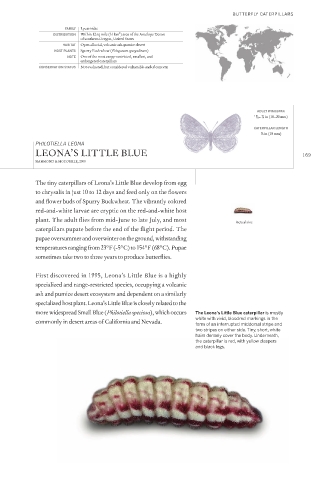
more widespread Small Blue (Philotiella speciosa), which occurs The Leona’s Little Blue caterpillar is mostly
commonly in desert areas of California and Nevada. white with vivid, bloodred markings in the
form of an interrupted middorsal stripe and
two stripes on either side. Tiny, short, white
hairs densely cover the body. Underneath,
the caterpillar is red, with yellow claspers
and black legs.

