


Page 173 - The Book of Caterpillars: A Life-Size Guide to Six Hundred Species From Around the World
P. 173
BUTTERFLY CATERPILLARS
FAMILY Lycaenidae
DISTRIBUTION Europe, east into southern Russia, Turkey, Iraq, and Iran
HABITAT Grassy slopes, especially on calcareous soil
HOST PLANTS Horseshoe Vetch (Hippocrepis comosa), other Hippocrepis spp.,
Coronilla spp., Lotus spp., and Securigera spp.
NOTE Green-and-yellow caterpillar that is tended by ants
CONSERVATION STATUS Not evaluated
ADULT WINGSPAN
1⁄–1⅜ in (30–35mm)
CATERPILLAR LENGTH
⁄–⁄ in (15–18mm)
POLYOMMATUS BELLARGUS
ADONIS BLUE 171
(ROTTEMBURG, 1775)
The female Adonis Blue lays her eggs, singly, on the underside
of leaves of the host plant, especially those growing in short
grass. The caterpillars hatch and feed by day; in early instars,
they consume the underside of leaves, leaving the upper surface Actual size
intact. More mature larvae rest openly on leaves, moving to the
base of the host plant, or on soil beside it, at dusk. They also
pupate on the ground, usually in a small hollow.
There are two generations a year, with the first on the wing from
May to June and the second from August to September. The
caterpillars of the second generation overwinter and become
active in spring. The larvae are attended by ants, especially
those of the genera Myrmicia, Lasius, and Tapinoma. The ants
feed on the caterpillar’s sweet secretions and in return protect
it from parasites and predators. The ants may even bury the
overwintering caterpillar or pupa underground in a chamber
linked to their nest.
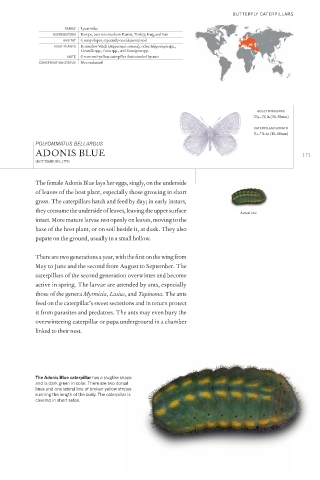
The Adonis Blue caterpillar has a sluglike shape
and is dark green in color. There are two dorsal
lines and one lateral line of broken yellow stripes
running the length of the body. The caterpillar is
covered in short setae.

