


Page 174 - The Book of Caterpillars: A Life-Size Guide to Six Hundred Species From Around the World
P. 174
BUTTERFLY CATERPILLARS
FAMILY Lycaenidae
TRIBUTION
DIS
DISTRIBUTION North Africa, across Europe into Russia and the Middle East
DISTRIBUTION
HABITAT
HABITAT T Oak woodlands, parks, and sometimes gardens with oak trees
HABIT
A
HOST PLANTS
HOST PLANTS
HOS T PLANT S Oak (Quercus spp.)
NO
NOTE Brown, sluglike caterpillar that feeds on young oak leaves
TE
NOTE
CONSERVATION STATUS Not evaluated, but declining across much of its range
CONSERV
CONSERVATION STATUS
T
TION S
A
TUS
A
ADULT WINGSPAN
⁄–1⅛ in (24–28 mm)
CATERPILLAR LENGTH
⁄–⁄ in (15–18 mm)
QUERCUSIA QUERCUS
PURPLE HAIRSTREAK
172
(LINNAEUS, 1758)
The eggs from which Purple Hairstreak caterpillars hatch are
laid singly at the base of oak buds, where they remain for the
winter. The larvae emerge in spring and burrow into the bud,
out of sight of predators, to feed on the young leaves. The older
caterpillar spins a loose silk web over a cluster of leaves and
remains within it, feeding at night. When mature, the caterpillar
Actual size drops to the ground to pupate. Here, it may be tended by ants
that bury it in the leaf litter.
There is a single generation. The iridescent adult butterflies are
on the wing high up in the oak canopy from June to August,
so are often overlooked. The species depends on the oak tree
to complete its life cycle, and numbers have declined as oak
woodland has been lost. The species is also sometimes referred
to as Favonius quercus.
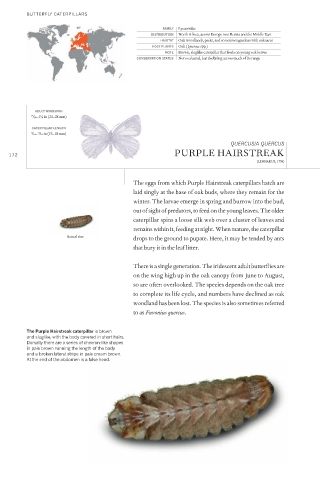
The Purple Hairstreak caterpillar is brown
and sluglike, with the body covered in short hairs.
Dorsally there are a series of chevron-like shapes
in pale brown running the length of the body
and a broken lateral stripe in pale cream brown.
At the end of the abdomen is a false head.

