


Page 175 - The Book of Caterpillars: A Life-Size Guide to Six Hundred Species From Around the World
P. 175
BUTTERFLY CATERPILLARS
FAMILY Lycaenidae
DISTRIBUTION Western North America, from British Columbia to New Mexico
HABITAT Oak-pine forest openings, canyons, riparian areas, and
shrub-steppe
HOST PLANTS Bitterbrush (Purshia tridentata)
NOTE Well-camouflaged caterpillar that feeds on buds and leaves
CONSERVATION STATUS Not evaluated, but periodically numbers fluctuate widely
ADULT WINGSPAN
1–1³∕₈ in (25–35 mm)
CATERPILLAR LENGTH
¹∕₁₆ in (17 mm)
SATYRIUM BEHRII
BEHR’S HAIRSTREAK 173
(W. H. EDWARDS, 1870)
Behr’s Hairstreak caterpillars hatch from eggs laid on
Bitterbrush stems, with which they contrast sharply. The eggs
are not hidden in crevices but placed on exposed surfaces,
where they overwinter, hatching in spring when the host plant
starts sprouting new leaves. Initially, the caterpillars feed only
on Bitterbrush buds, hollowing out the contents completely
with their extendable necks. When half grown, they feed on Actual size
leaves. Their coloring blends well with the pastel-green host
plant, providing excellent camouflage and protection from
enemies. The caterpillars develop through four instars and do
not construct nests.
Mature larvae leave the host plant and pupate under cover
about 24 days after hatching. The adults emerge two weeks
later. Hairstreaks may be locally common but are subject to
wide fluctuations in population numbers and may be scarce
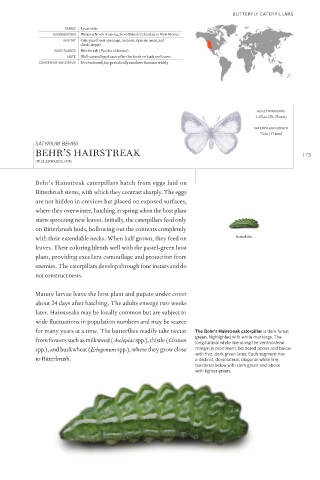
for many years at a time. The butterflies readily take nectar The Behr’s Hairstreak caterpillar is dark forest
from flowers such as milkweed (Asclepias spp.), thistle (Cirsium green, highlighted with white markings. The
longitudinal white line along the ventrolateral
spp.), and buckwheat (Eriogonum spp.), where they grow close margin is prominent, bordered above and below
to Bitterbrush. with thin, dark green lines. Each segment has
a distinct, dorsolateral, diagonal white line,
bordered below with dark green and above
with lighter green.

