


Page 176 - The Book of Caterpillars: A Life-Size Guide to Six Hundred Species From Around the World
P. 176
BUTTERFLY CATERPILLARS
FAMILY Lycaenidae
DISTRIBUTION North America, south to Colombia and Venezuela
HABITAT Most habitats, from urban areas to mountaintops, avoiding
dense forest
HOST PLANTS Very wide range, often pea (Fabaceae) and mallow
(Malvaceae) families
NOTE Versatile feeder that adopts the colors of its host plant
CONSERVATION STATUS Not evaluated, but common except at the periphery of its range
ADULT WINGSPAN
1–1³∕₈ in (25–35 mm)
CATERPILLAR LENGTH
¹∕₁₆ in (17 mm)
STRYMON MELINUS
GRAY HAIRSTREAK
174
HÜBNER, 1818
The Gray Hairstreak caterpillar is a true generalist feeder that
will develop on just about any plant—native or introduced.
It hatches in about three days from eggs laid on buds, flowers,
or leaves; pupation occurs 27 days later. The larvae prefer to
feed on flowers and will adopt the color of the flower on which
they are feeding. However, if flowers are not available, they will
readily feed on leaves and other plant parts. Ant associations
occur and help defend the caterpillars from enemies.
Pupation takes place in a sheltered location, such as a curled
leaf, and the pupa usually overwinters. There are multiple
generations annually, depending on latitude and elevation.
Sometimes, the caterpillars cause problems for commercial bean
production, but it is rare for large numbers of them to occur in
small areas. The Gray Hairstreak is one of the first butterflies
to emerge in spring and one of the last to stop flying in late fall.
Actual size
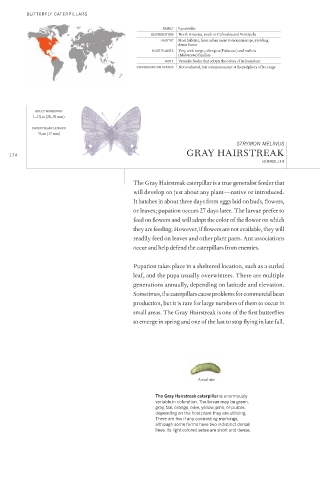
The Gray Hairstreak caterpillar is enormously
variable in coloration. The larvae may be green,
gray, tan, orange, olive, yellow, pink, or purple,
depending on the host plant they are utilizing.
There are few if any contrasting markings,
although some forms have two indistinct dorsal
lines. Its light colored setae are short and dense.

