


Page 177 - The Book of Caterpillars: A Life-Size Guide to Six Hundred Species From Around the World
P. 177
BUTTERFLY CATERPILLARS
FAMILY Lycaenidae
DISTRIBUTION Parts of Africa, the Middle East, the Balkans, Iran, and much
of India
HABITAT Dry savannahs
HOST PLANTS Christ’s Thorn (Paliurus spinus-christi) and Ziziphus spp.
NOTE Green caterpillar that lives in hot, dry grasslands
CONSERVATION STATUS Least concern
ADULT WINGSPAN
⁄–⅞ in (18–22 mm)
CATERPILLAR LENGTH
⅜–½ in (10–12 mm)
TARUCUS BALKANICUS
LITTLE TIGER BLUE 175
(FREYER, 1844)
The female Little Blue Tiger, also known as the Balkan
Pierrot, lays her eggs at the base of thorns on the host plant and
occasionally on leaves. The caterpillars nibble away a groove on
the underside of the leaf, leaving a characteristic transparent bar
in the leaf surface. The species overwinters as a pupa. The fast-
flying adults—the male much bluer in color than the browner
female—eclose and are on the wing from April through to the
end of summer, and there is a series of overlapping broods.
In the Balkans, the area of southeast Europe after which the
species is named, there has been a considerable decline in
the population, by as much as 30 percent in some areas, but
numbers are holding up well in other parts of its range. There are
several subspecies, including the Black-spotted Pierrot (Tarucus
balkanicus nigra), which is found in India. The Tarucus genus
comprises 23 species, commonly known as blue Pierrots.
Actual size
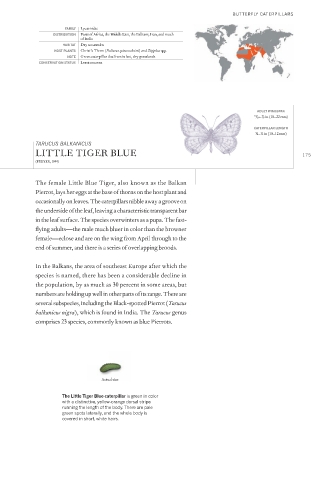
The Little Tiger Blue caterpillar is green in color
with a distinctive, yellow-orange dorsal stripe
running the length of the body. There are pale
green spots laterally, and the whole body is
covered in short, white hairs.

