


Page 178 - The Book of Caterpillars: A Life-Size Guide to Six Hundred Species From Around the World
P. 178
BUTTERFLY CATERPILLARS

                                                     FAMILY  Lycaenidae
                                                 DISTRIBUTION  Southeastern Indonesia, Timor, mainland New Guinea,
                                                          and Australia
                                                    HABITAT  Eucalypt woodlands and open forests; also semi-arid and
                                                          arid scrublands
                                                  HOST PLANTS  Mainly wattle (Acacia spp.), but also small gum trees
                                                          (Eucalyptus spp.) and occasionally species of Fabaceae,
                                                          Sapindaceae, and Combretaceae

                                                      NOTE  One of the few butterfly caterpillars that feeds on Eucalyptus
                                             CONSERVATION STATUS  Not evaluated, but common in northern areas of its range


            ADULT WINGSPAN
             ⅞ in (22 mm)
           CATERPILLAR LENGTH
             ½ in (13 mm)
                                                                         THECLINESTHES MISKINI
                                                                     WATTLE BLUE
    176
                                                                                   (T. P. LUCAS, 1889)


                                            The Wattle Blue caterpillar is often attended by numerous
                                            ants from one of five genera. The ants may provide some
                                            protection from predators and parasitoids, and in return
                                            the caterpillars supply the ants with nutrient-rich secretions. The
                                            caterpillars feed openly on the young leaves and sometimes on


                                            the fleshy galls and flowers of their host plants—often small
                      Actual size
                                            trees, and seedlings or suckers from larger trees. The larvae are
                                            sometimes found in ant nests or under leaf litter on the ground.
                                            In warmer areas, the caterpillars complete their development
                                            in four weeks or less.


                                            The caterpillars generally pupate on the food plant and are
                                            attached by anal hooks and a central silk girdle. The species
                                            is common in central and northern Australia, breeding there
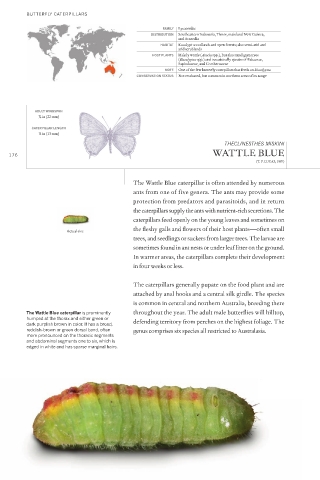
         The Wattle Blue caterpillar is prominently   throughout the year. The adult male butterflies will hilltop,
         humped at the thorax and either green or   defending territory from perches on the highest foliage. The
         dark purplish brown in color. It has a broad,
         reddish-brown or green dorsal band, often   genus comprises six species all restricted to Australasia.
         more pronounced on the thoracic segments
         and abdominal segments one to six, which is
         edged in white and has sparse marginal hairs.

