


Page 179 - The Book of Caterpillars: A Life-Size Guide to Six Hundred Species From Around the World
P. 179
BUTTERFLY CATERPILLARS
FAMILY Lycaenidae
DISTRIBUTION Portugal, Spain, southern France, and North Africa
HABITAT Dry grasslands and meadows up to 5,600 ft (1,700 m) elevation
HOST PLANTS Various Fabaceae members, including Anthyllis spp.,
Astragalus spp., Dorycnium spp., Lotus spp., and Medicago spp.
NOTE Olive-green caterpillar that is tended by ants
CONSERVATION STATUS Not evaluated
ADULT WINGSPAN
1⅛–1⁄ in (28–30 mm)
CATERPILLAR LENGTH
⁄–⁄ in (15–18 mm)
TOMARES BALLUS
PROVENCE HAIRSTREAK 177
(FABRICIUS, 1787)
Provence Hairstreak caterpillars hatch from small, pale eggs laid
by the female butterfly, who hides them under a leaf of the host
plant. The young larvae burrow into flower buds, where they
feed out of sight of predators, sometimes taking on the color of
the flower to improve their camouflage. The more mature larvae
emerge and feed on leaves. Ants of various genera, including Actual size
Plagiolepis, attend the caterpillars, feeding on the sugary
secretion (honeydew) produced by the larvae and in return
protecting them from parasites and predators. The caterpillar
is often transported by ants into their anthill to pupate, and the
brown pupa will overwinter there.
There is a single generation annually, and the butterflies are seen
on the wing from January to April. The species is endangered
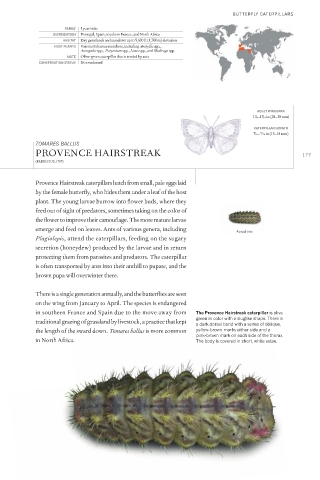
in southern France and Spain due to the move away from The Provence Hairstreak caterpillar is olive
traditional grazing of grassland by livestock, a practice that kept green in color with a sluglike shape. There is
a dark dorsal band with a series of oblique,
the length of the sward down. Tomares ballus is more common yellow-brown marks either side and a
in North Africa. pink-brown mark on each side of the thorax.
The body is covered in short, white setae.

