


Page 180 - The Book of Caterpillars: A Life-Size Guide to Six Hundred Species From Around the World
P. 180
BUTTERFLY CATERPILLARS

                                                     FAMILY  Nymphalidae
                                                 DISTRIBUTION  The Himalayas, northeast India, southern China, Chinese Taipei,
                                                          and much of Southeast Asia
                                                    HABITAT  Open forests and disturbed areas where invasive host

                                                          plants flourish
                                                  HOST PLANTS  Members of nettle family (Urticaceae), including Boehmeria spp.,
                                                          Debregeasia spp., Elatostema spp, Urtica spp., and Pouzolzia spp.;
                                                          also Buddleja spp.
                                                      NOTE  Hungry, unpalatable, foul-smelling, spiny caterpillars that
                                                          live en masse
                                             CONSERVATION STATUS  Not evaluated, but locally common


            ADULT WINGSPAN
           2⅜–2¾ in (60–70 mm)
           CATERPILLAR LENGTH


             1⅜ in (35 mm)
                                                                               ACRAEA ISSORIA
                                                               YELLOW COSTER
    178
                                                                                    (HÜBNER, 1819)


                                            Yellow Coster females lay several dozen eggs on the undersides
                                            of leaves, which take around 20 days to hatch. The caterpillars
                                            live gregariously and, as a result, frequently defoliate their host
                                            plants. Like the adult butterfly, the caterpillars are known to be


                                            unpalatable and malodorous to predators, but they can suffer
                                            heavy losses to parasitoid fl ies and wasps in the pupal stage.
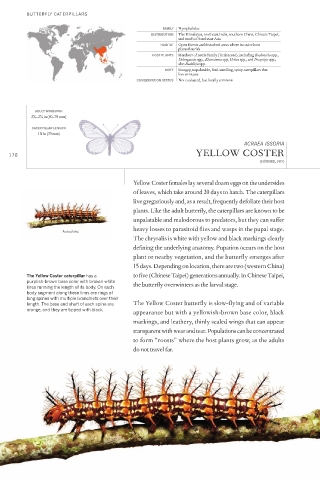
                     Actual size
                                            The chrysalis is white with yellow and black markings clearly
                                            defining the underlying anatomy. Pupation occurs on the host

                                            plant or nearby vegetation, and the butterfly emerges after
                                            15 days. Depending on location, there are two (western China)

          The Yellow Coster caterpillar has a   to five (Chinese Taipei) generations annually. In Chinese Taipei,
          purplish-brown base color with broken white   the butterfly overwinters as the larval stage.

          lines running the length of its body. On each
          body segment along these lines are rings of
          long spines with multiple branchlets over their
          length. The base and shaft of each spine are   The Yellow Coster butterfly is slow-flying and of variable
          orange, and they are tipped with black.  appearance but with a yellowish-brown base color, black
                                            markings, and leathery, thinly scaled wings that can appear
                                            transparent with wear and tear. Populations can be concentrated
                                            to form “roosts” where the host plants grow, as the adults
                                            do not travel far.

