


Page 181 - The Book of Caterpillars: A Life-Size Guide to Six Hundred Species From Around the World
P. 181
BUTTERFLY CATERPILLARS
FAMILY Nymphalidae
DISTRIBUTION Western United States, Mexico
HABITAT Oak woodlands and riparian areas
HOST PLANTS Oak (Quercus spp.)
NOTE Caterpillar that has a variety of defense plans
CONSERVATION STATUS Not evaluated, but common
ADULT WINGSPAN
3–3⅛ in (75–80 mm)
CATERPILLAR LENGTH
1⅜–1⁄ in (35–40 mm)
ADELPHA CALIFORNICA
CALIFORNIA SISTER 179
(BUTLER, 1865)
California Sister caterpillars are masters of defense, employing
camouflage, chemistry, and aggression to avoid predators.
They feed only on oak leaves and adopt a variety of protective
strategies that change during development. The newly hatched
caterpillar feeds at the edge of a leaf, forming a pier from a vein
or midrib. Frass is used to extend this pier, which the caterpillar Actual size
rests upon when not feeding, and which somehow confers
protection. Mid-stage caterpillars adopt a cryptic serpentine
posture when at rest, while mature caterpillars are aggressive
and will attempt to bite if disturbed.
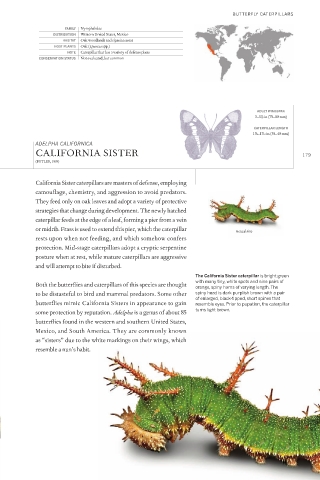
The California Sister caterpillar is bright green
Both the butterflies and caterpillars of this species are thought with many tiny, white spots and nine pairs of
orange, spiny horns of varying length. The
to be distasteful to bird and mammal predators. Some other spiny head is dark purplish brown with a pair
butterflies mimic California Sisters in appearance to gain of enlarged, black-tipped, short spines that
resemble eyes. Prior to pupation, the caterpillar
some protection by reputation. Adelpha is a genus of about 85 turns light brown.
butterfl ies found in the western and southern United States,
Mexico, and South America. They are commonly known
as “sisters” due to the white markings on their wings, which
resemble a nun’s habit.

