


Page 182 - The Book of Caterpillars: A Life-Size Guide to Six Hundred Species From Around the World
P. 182
BUTTERFLY CATERPILLARS
FAMILY Nymphalidae
DISTRIBUTION Europe, much of Asia, east to Japan; also a small population
recently discovered in New England, United States
HABITAT Open woodlands, meadows, parks, gardens, and grasslands up to
8,200 ft (2,500 m) elevation
HOST PLANTS Nettle (Urtica spp.) and hop (Humulus spp.)
NOTE Jet-black, spiny caterpillar that builds a communal web
CONSERVATION STATUS Not evaluated, but common
ADULT WINGSPAN
2⅛–2⅜ in (55–60 mm)
CATERPILLAR LENGTH
1⁄–1¾ in (40–45 mm)
AGLAIS IO
PEACOCK
180
(LINNAEUS, 1758)
Peacock caterpillars hatch from green eggs laid in an untidy mass
of up to 400 on the underside of a stinging nettle leaf. First instars
build a communal web near the top of the plant, from which they
emerge to bask and feed, and are usually highly conspicuous.
Feeding may occur at any time of the day and night. As the
caterpillars develop, they move to new plants, building new
webs along the way. Webs are decorated with shed larval skins
and frass, and are easily found.
The caterpillars have several strategies to avoid predation.
If disturbed, a group of larvae will often jerk their bodies from
side to side in unison—probably to appear larger—while a
single caterpillar may regurgitate bitter, green fluid, curl up
in a ball, and drop to the ground. There are five instars, and
mature larvae leave the plant to pupate in nearby vegetation.
The Peacock is a long-lived butterfly that overwinters as an adult
and is one of the first butterflies to be seen in spring.
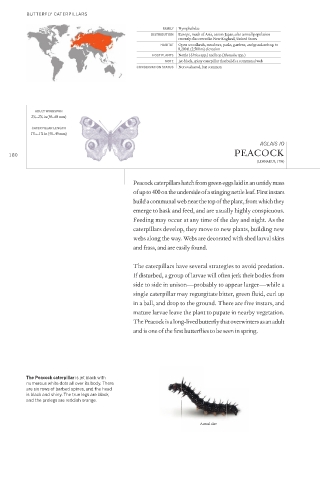
The Peacock caterpillar is jet black with
numerous white dots all over its body. There
are six rows of barbed spines, and the head
is black and shiny. The true legs are black,
and the prolegs are reddish orange.
Actual size

