


Page 183 - The Book of Caterpillars: A Life-Size Guide to Six Hundred Species From Around the World
P. 183
BUTTERFLY CATERPILLARS
FAMILY Nymphalidae
DISTRIBUTION North America, except far north and far south
HABITAT Wherever stinging nettles grow in the lowlands and mountains,
especially along watercourses
HOST PLANTS Nettle (Urtica spp.)
NOTE Gregarious, spiny caterpillar
CONSERVATION STATUS Not evaluated, but common
ADULT WINGSPAN
1⁄–1¾ in (40–45 mm)
CATERPILLAR LENGTH
1–1⁄ in (25–30 mm)
AGLAIS MILBERTI
FIRE-RIM TORTOISESHELL 181
(GODART, 1819)
Fire-rim Tortoiseshell caterpillars hatch from eggs laid in
untidy masses of 20 to 900, often piled on top of each other,
usually on the underside of a terminal nettle leaf. First instar
larvae feed communally, skeletonizing and webbing leaves.
Webbing increases in second and third instars, providing
access and support for caterpillars between leaves and shoots.
Fourth and fifth instars become solitary and live in folded nettle
leaves tied with silk. Prepupal caterpillars wander, and most
pupae are formed away from nettles.
Development is rapid, pupation occurring three weeks after
egg hatch. Protection from enemies is based on aggregation
in early instars and concealment later. Mature caterpillars also
gain protection from being very spiny. Natural enemies include
predatory bugs and parasitic wasps. Fire-rim Tortoiseshell
butterflies may migrate from lowlands to high-elevation areas in
summer to escape hot and dry conditions. The adults overwinter
and may live for up to ten months.
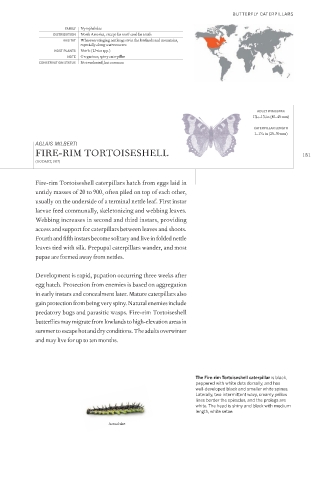
The Fire-rim Tortoiseshell caterpillar is black,
peppered with white dots dorsally, and has
well-developed black and smaller white spines.
Laterally, two intermittent wavy, creamy yellow
lines border the spiracles, and the prolegs are
white. The head is shiny and black with medium
length, white setae.
Actual size

