


Page 184 - The Book of Caterpillars: A Life-Size Guide to Six Hundred Species From Around the World
P. 184
BUTTERFLY CATERPILLARS
FAMILY Nymphalidae
DISTRIBUTION From Europe across Asia to the Pacific coast; also a small
population recently discovered in New England, United States
HABITAT Varied, from parks and gardens to farmlands, grasslands,
and woodlands
HOST PLANTS Nettle (Urtica dioica and U. urens)
NOTE Caterpillar that, when young, clusters in silk webs on nettle
CONSERVATION STATUS Not evaluated
ADULT WINGSPAN
1¾–2⁄ in (45–65 mm)
CATERPILLAR LENGTH
¾–⅞ in (20–22 mm)
AGLAIS URTICAE
SMALL TORTOISESHELL
182
(LINNAEUS, 1758)
Small Tortoiseshell caterpillars hatch from eggs laid on the
underside of leaves. The larvae are gregarious, clustering
together in the safety of a silken web. They emerge from the
web to feed and bask in the sun. As they move from plant to
plant in search of food, they build a new web, leaving a trail of
defoliated stems, silk threads, and droppings. When disturbed,
a group of caterpillars will twist their bodies from side to side
to deter a would-be predator. Sometimes, they roll up and
drop to the ground. After the last molt, they disperse and pupate.
Typically, there are two generations a year, with the adults of
the second generation overwintering in caves and buildings
such as garages and sheds. In some parts of this species’ range,
particularly in Europe, there has been a steep decline in numbers.
Some scientists suspect that this is linked to global warming and
increasing numbers of the parasitic fly, Sturma bella.
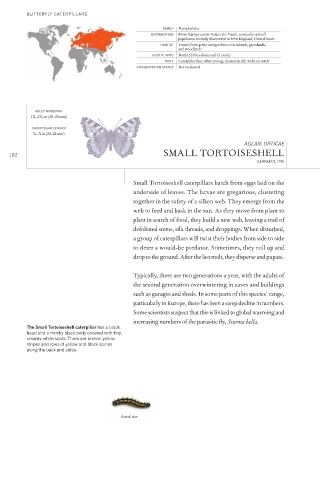
The Small Tortoiseshell caterpillar has a black
head and a mostly black body covered with tiny,
creamy-white spots. There are broken yellow
stripes and rows of yellow and black spines
along the back and sides.
Actual size

