


Page 185 - The Book of Caterpillars: A Life-Size Guide to Six Hundred Species From Around the World
P. 185
BUTTERFLY CATERPILLARS
FAMILY Nymphalidae
DISTRIBUTION From southern United States (San Francisco Bay area
in the west and Virginia in the east) and the Caribbean,
south to central Argentina
HABITAT Open areas, disturbed habitats, and suburbs where its host
plant occurs
HOST PLANTS Passion vine (Passi ora spp.)
NOTE Aposematic caterpillar protected against predators by toxic
plant alkaloids
CONSERVATION STATUS Not evaluated, but common
ADULT WINGSPAN
2⅛–3¾ in (60–95 mm)
CATERPILLAR LENGTH
1⁄ in (40 mm)
AGRAULIS VANILLAE
GULF FRITILLARY 183
(LINNAEUS, 1758)
Gulf Fritillary caterpillars hatch from yellow eggs laid on
or near their food plant, where the larvae feed on all parts,
sometimes defoliating the host. Although the caterpillars are
protected from most predators by spines and black-and-orange
coloration, warning of the toxicity conferred by plant alkaloids,
in California the Greater Roadrunner (Geococcyx californianus)
still finds a way to feed on them. Paper wasps, ants, lizards,
predatory bugs, and praying mantids will also eat the larvae.
Many are killed by parasitic tachinid flies—in Florida up to
90 percent can be parasitized in the fall.
Mature larvae pupate in a chrysalis resembling a dead leaf;
in north Florida, larvae may hibernate through the winter
when their host plant freezes until it sprouts fresh growth in the
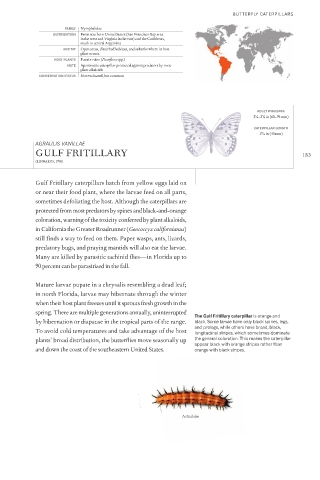
spring. There are multiple generations annually, uninterrupted The Gulf Fritillary caterpillar is orange and
by hibernation or diapause in the tropical parts of the range. black. Some larvae have only black spines, legs,
To avoid cold temperatures and take advantage of the host and prolegs, while others have broad, black,
longitudinal stripes, which sometimes dominate
plants’ broad distribution, the butterfl ies move seasonally up the general coloration. This makes the caterpillar
and down the coast of the southeastern United States. appear black with orange stripes rather than
orange with black stripes.
Actual size

