


Page 186 - The Book of Caterpillars: A Life-Size Guide to Six Hundred Species From Around the World
P. 186
BUTTERFLY CATERPILLARS
FAMILY Nymphalidae
DISTRIBUTION The Andes of Venezuela, south through Bolivia
HABITAT Subtemperate to upper subtropical forest edges and second growth
HOST PLANTS Erato spp.
NOTE Warningly colored caterpillars that are undoubtedly toxic to
some predators
CONSERVATION STATUS Not evaluated, but not considered threatened
ADULT WINGSPAN
2⅝–2⅞ in (66–73 mm)
CATERPILLAR LENGTH
1⁄–1⅞ in (40–48 mm)
ALTINOTE DICAEUS
RED-BANDED ALTINOTE
184
(LATREILLE, [1817])
In many parts of its range, the Red-banded Altinote caterpillar
is among the most commonly encountered and conspicuous of
lepidopterous larvae. This is due, in part, to the fact that the eggs
are laid in clusters of 50 to 110, with the hatching cohorts quickly
devouring one host plant before munching down a second.
Additionally, some time after the third instar, larvae disperse
and crawl away to find food where there are fewer siblings to
compete with, so are more likely to be seen as they wander
farther afield. Pupation occurs after a period of wandering, often
some distance away from the food plant, but with pupae always
hanging in a sheltered cranny under a leaf or branch, or even
the eaves of a house.
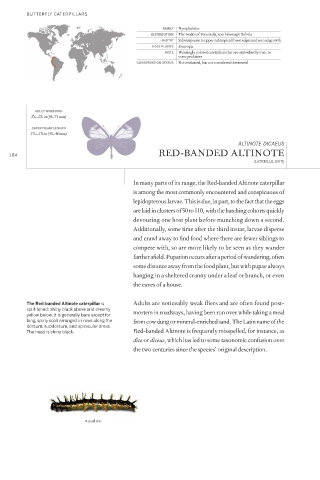
The Red-banded Altinote caterpillar is Adults are noticeably weak fliers and are often found post-
split-toned: shiny black above and creamy mortem in roadways, having been run over while taking a meal
yellow below. It is generally bare except for
long, spiny scoli arranged in rows along the from cow dung or mineral-enriched sand. The Latin name of the
dorsum, subdorsum, and spiracular areas.
The head is shiny black. Red-banded Altinote is frequently misspelled, for instance, as
dice or diceus, which has led to some taxonomic confusion over
the two centuries since the species’ original description.
Actual size

