


Page 187 - The Book of Caterpillars: A Life-Size Guide to Six Hundred Species From Around the World
P. 187
BUTTERFLY CATERPILLARS
FAMILY Nymphalidae
DISTRIBUTION The Andes, from Venezuela to at least central Peru
HABITAT Cloud forests dominated by Chusquea bamboo around
landslides and forest edges
HOST PLANTS Bamboo (Chusquea spp.)
NOTE Caterpillar that changes color but keeps its tails
throughout development
CONSERVATION STATUS Not evaluated, but not considered threatened
ADULT WINGSPAN
3¼–3⁄ in (82–88 mm)
CATERPILLAR LENGTH
2⁄–2¼ in (52–57 mm)
ANTIRRHEA ADOPTIVA
ADOPTED MORPHET 185
(WEYMER, 1909)
Adopted Morphet caterpillars hatch from flattened, dome-
shaped eggs laid in neat rows of two to seven on the underside of
host leaves. First instar larvae feed in loose aggregations on the
same leaf, but in the second and subsequent instars individuals
disperse to adjacent leaves, with the distance between larvae
increasing with age. They are frequently attacked by parasitic
flies and wasps but have a small, pinkish, eversible neck gland
that, presumably, helps deter their enemies. On the dorsum of
the thorax, a pair of silvery-colored fissures mark the openings
of “grooming glands” whose exact function is poorly known.
From oviposition to adult, the life cycle is quite variable
in length, taking from 120 to 143 days. The butterflies are
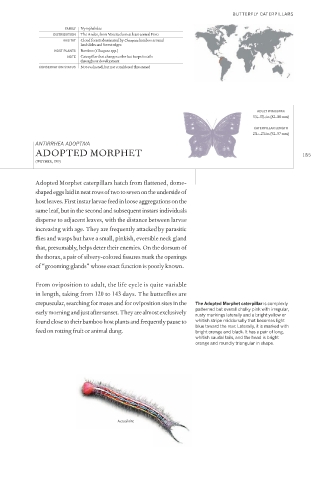
crepuscular, searching for mates and for oviposition sites in the The Adopted Morphet caterpillar is complexly
early morning and just after sunset. They are almost exclusively patterned but overall chalky pink with irregular,
rusty markings laterally and a bright yellow or
found close to their bamboo host plants and frequently pause to whitish stripe middorsally that becomes light
feed on rotting fruit or animal dung. blue toward the rear. Laterally, it is marked with
bright orange and black. It has a pair of long,
whitish caudal tails, and the head is bright
orange and roundly triangular in shape.
Actual size

