


Page 209 - The Book of Caterpillars: A Life-Size Guide to Six Hundred Species From Around the World
P. 209
BUTTERFLY CATERPILLARS

                      FAMILY  Nymphalidae
                  DISTRIBUTION  Northern, eastern, and southern Australia
                     HABITAT  Wide range of lightly wooded habitats, including urban areas
                  HOST PLANTS  More than 45 hosts recorded; commonly wattles (Acacia spp.)
                           but also plants from other families, including Caesalpiniaceae
                           and Sterculiaceae
                      NOTE  Large, variably banded, and colorful caterpillar
             CONSERVATION STATUS  Not evaluated, but in low densities throughout most of its range


                                                                                   ADULT WINGSPAN
                                                                                  3–3⅜ in (75–85 mm)
                                                                                  CATERPILLAR LENGTH
                                                                                    2⅛ in (55 mm)
            CHARAXES SEMPRONIUS
            TAILED EMPEROR                                                                       207

            (FABRICIUS, 1793)


            Tailed Emperor caterpillars hatch from round, green-and-brown
            eggs laid singly on host plants and feed openly on the leaves,
            mostly at night. During the day, and during molts, they rest
            on a silken pad spun on the upper side of a leaf. Even in early
            instars, the caterpillar’s small head is adorned with two pairs of
            long horns. In the cooler, southern areas of the species’ range
            there are two generations a year, with three to  ve generations

            occurring in northern regions, where the larvae can be found
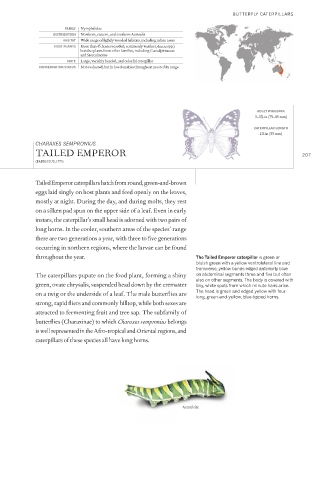
            throughout the year.                                The Tailed Emperor caterpillar is green or
                                                                bluish green with a yellow ventrolateral line and
                                                                transverse, yellow bands edged anteriorly blue
            The caterpillars pupate on the food plant, forming a shiny   on abdominal segments three and   ve but often
            green, ovate chrysalis, suspended head down by the cremaster   also on other segments. The body is covered with
                                                                tiny, white spots from which minute hairs arise.
            on a twig or the underside of a leaf. The male butter  ies are   The head is green and edged yellow with four
                                                                long, green-and-yellow, blue-tipped horns.

            strong, rapid  iers and commonly hilltop, while both sexes are
            attracted to fermenting fruit and tree sap. The subfamily of
            butter ies (Charaxinae) to which Charaxes sempronius belongs

            is well represented in the Afro-tropical and Oriental regions, and
            caterpillars of these species all have long horns.


                                                           Actual size

