


Page 210 - The Book of Caterpillars: A Life-Size Guide to Six Hundred Species From Around the World
P. 210
BUTTERFLY CATERPILLARS

                                                     FAMILY  Nymphaliade
                                                 DISTRIBUTION  North Africa, southern Europe into central Asia, Siberia,
                                                          and across China to Korea
                                                    HABITAT  Dry, chalk grassland slopes with exposed rock outcrops
                                                          grazed by sheep
                                                  HOST PLANTS  Grasses, particularly Festuca ovina, but also other members
                                                          of Poaceae family
                                                      NOTE  Striped, brown caterpillar that is found on grazed grasslands
                                             CONSERVATION STATUS  Not evaluated, but threatened in parts of Europe


            ADULT WINGSPAN
           1¾–2⅜ in (45–60 mm)
           CATERPILLAR LENGTH
           1⅜–1 ⁄   in (35–40 mm)


                                                                              CHAZARA BRISEIS
                                                                               HERMIT
    208
                                                                                   (LINNAEUS, 1764)


                                            Hermit caterpillars hatch from conical-shaped, ridged eggs
                                            laid by the female butterfly on grasses, close to the ground,
                                            or sometimes on nearby moss and lichens. The larvae feed on
                                            grass, tending to prefer grazed or trampled tufts, and often they
                                            are active only at night. The caterpillars overwinter while still
                                            in an early instar and become active the following spring. They
                                            pupate in early summer, when their orange-brown pupae can be
                                            found at the base of the host plants.


                                            The brown-and-white adults can be seen in late summer,  ying

                                            from July to September. Chazara briseis is in sharp decline
                                            in central Europe due to its dependence on chalk grassland
                                            grazed short by sheep. This type of terrain is disappearing
                                            with the decrease in the traditional management of sheep
                                            by transhumance, in which sheep are moved up to higher
                                            slopes in summer, resulting in longer grass and colonization
                                            by shrub and tree species.


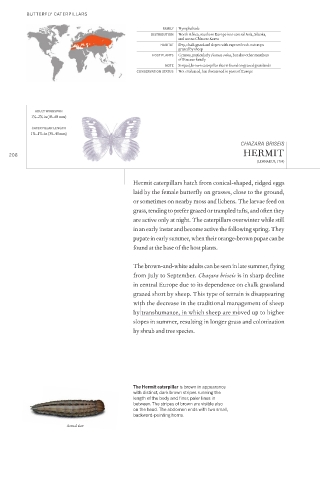
                                            The Hermit caterpillar is brown in appearance
                                            with distinct, dark brown stripes running the
                                            length of the body and   ner, paler lines in
                                            between. The stripes of brown are visible also
                                            on the head. The abdomen ends with two small,
                                            backward-pointing horns.
                      Actual size

