


Page 211 - The Book of Caterpillars: A Life-Size Guide to Six Hundred Species From Around the World
P. 211
BUTTERFLY CATERPILLARS

                      FAMILY  Nymphalidae
                  DISTRIBUTION  Northeast India, northern Myanmar, Thailand, Laos, and
                           southern Yunnan (China)
                     HABITAT  Open montane forests, at 3,300–6,600 ft (1,000–2,000 m) elevation
                  HOST PLANTS  Hackberry (Celtis spp.)
                      NOTE  Caterpillar whose head is heavily armored with horns and spines
             CONSERVATION STATUS  Not evaluated, but common across its range, occurring in
                           localized colonies


                                                                                   ADULT WINGSPAN
                                                                                  2 ⁄  –3⅜ in (65–85 mm)
                                                                                  CATERPILLAR LENGTH
                                                                                    2⅛ in (55 mm)
            CHITORIA NAGA
            NAGA EMPEROR                                                                         209

            (TYTLER, 1915)


            Naga Emperor caterpillars have a heavily horned head capsule
            with a pair of branched antlers and a trio of lengthy spikes either
            side of the head. Only when the larvae are mobile and feeding
            is the head held upright, otherwise it is pressed  ush against the

            leaf surface. Early instars are gregarious. The larvae rest on a
            silken mat on the underside of host leaves and feed on adjacent
            foliage. The chrysalis is also formed on the underside of leaves
            attached to the midrib. It is green and streamlined, with a yellow-
            edged dorsal crest and wing margins, twin cranial horns, and
            blue spiracles.


            The Apaturinae subfamily of nymphalid butter  ies includes
            many species known as “emperors.” The name “naga” refers
            to the mountainous Naga Hills district on the Indian–Myanmar
            border, where the species was described. Typical of many of the
            emperors, the butter y will often be seen feeding from leaking

            tree sap or basking high in the canopy.


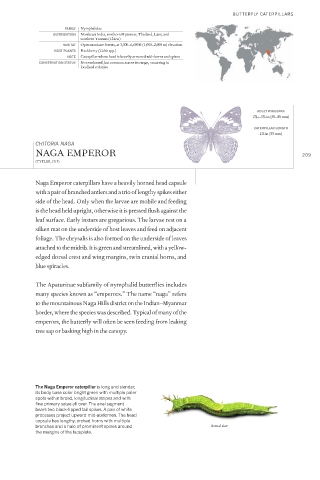
            The Naga Emperor caterpillar is long and slender,
            its body base color bright green with multiple paler
            spots within broad, longitudinal stripes and with
              ne primary setae all over. The anal segment
            bears two black-tipped tail spikes. A pair of white
            processes project upward mid-abdomen. The head
            capsule has lengthy, arched horns with multiple
            branches and a halo of prominent spines around          Actual size
            the margins of the faceplate.

