


Page 212 - The Book of Caterpillars: A Life-Size Guide to Six Hundred Species From Around the World
P. 212
BUTTERFLY CATERPILLARS

                                                     FAMILY  Nymphalidae
                                                 DISTRIBUTION  North America, from southwest and south central Canada south
                                                          to Nebraska and New Mexico
                                                    HABITAT  Sage deserts, savannahs, washes, gulches, and canyons


                                                  HOST PLANTS  Rabbitbrush (Chrysothamnus viscidi orus) and  eabane
                                                          (Erigeron spp.)
                                                      NOTE  Spiny caterpillars that overwinter en masse underneath host plants
                                             CONSERVATION STATUS  Not evaluated, but common


            ADULT WINGSPAN


           1⅜–1¾ in (35–45 mm)
           CATERPILLAR LENGTH
           1–1 ⁄   in (25–30 mm)
                                                                            CHLOSYNE ACASTUS
                                               SAGEBRUSH CHECKERSPOT
    210
                                                                                (W. H. EDWARDS, 1874)


                                            Female Sagebrush Checkerspots lay eggs in May in large
                                            clusters of 100 to 150 on the undersides of leaves at the base of
                                            Rabbitbrush plants. The young caterpillars hatch after six days
                                            and feed immediately, developing until the third instar, when
                                            they become dormant. The gregarious larvae seek refuge en
                                            masse at the base of the plant, where they oversummer and
                                            overwinter in dormancy. Feeding resumes in early spring,
                                            resulting in adults during April. Post-dormancy caterpillars are
                                            solitary, feed diurnally, and rest openly. Protection is based on
                                            gregariousness and sheltering in the early instars, whereas later
                                            instars depend on their spines and a ventral “neck” gland, which
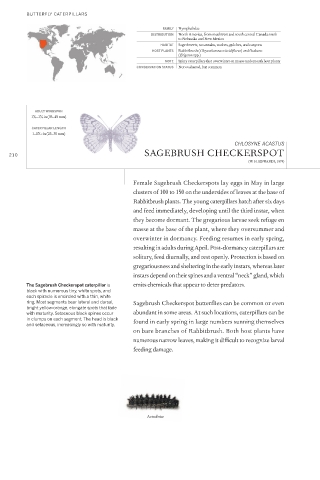
         The Sagebrush Checkerspot caterpillar is   emits chemicals that appear to deter predators.
         black with numerous tiny, white spots, and
         each spiracle is encircled with a thin, white
         ring. Most segments bear lateral and dorsal,   Sagebrush Checkerspot butterflies can be common or even
         bright yellow-orange, elongate spots that fade
         with maturity. Setaceous black spines occur   abundant in some areas. At such locations, caterpillars can be
         in clumps on each segment. The head is black   found in early spring in large numbers sunning themselves
         and setaceous, increasingly so with maturity.
                                            on bare branches of Rabbitbrush. Both host plants have
                                            numerous narrow leaves, making it di cult to recognize larval


                                            feeding damage.


                                                Actual size

